History of the Creation and Development of TRIZ
People, Ideas, and Personal Memories

Part 1. From the Introduction to the Beginning of Joint Work by Altshuller and Shapiro
About This Story
This story is dedicated to the history of the creation and development of TRIZ—the Theory of Inventive Problem Solving. However, it will not be merely a chronology of the emergence of individual methods, principles, and tools. Above all, I want to tell about the people who created TRIZ, and, of course, first and foremost about Genrich Saulovich Altshuller.
I was fortunate to know Genrich Saulovich well. We conducted seminars together, talked a lot, and discussed TRIZ, its history, individual tools, and the people who participated in its development. We also had deeply personal conversations—about his life, childhood, first inventions, and work on TRIZ.
Genrich Saulovich once asked me to call him simply Genrich in our private conversations. Therefore, in my narrative I will sometimes say, “Genrich told me…,” and at other times, more customarily, “Genrich Saulovich.” Much of what I recount I heard directly from him. However, I also use documents, publications, and memoirs of people who knew Genrich Saulovich well and participated in the development of TRIZ. Different people remembered certain events differently. In such cases, I will not smooth over the differences, but will try to present them and indicate the source of each version.
A Little About Myself

Before moving on to the main topic, I would like to tell a little about myself. I was born on July 25, 1945, in Leningrad, in the Soviet Union. Today this is Saint Petersburg, Russia. I consider myself a very fortunate person, and I have several reasons for this.
First of all, I was lucky with my parents. Both were renowned shipbuilders: my mother worked on building surface ships, and my father worked on submarines. During the war, they volunteered for the army, but they were soon returned to their work because they were indispensable as specialists. My parents spent the entire siege in Leningrad.
I was fortunate to be born in a wonderful city—with a rich culture, many museums and theaters, and strong technical and industrial traditions. During my school years, I attended a study club at the Hermitage. We were given fascinating lectures, guided through the halls, and told about history and paintings. Members of the club had a special privilege: free admission to the Hermitage throughout the entire working day and access through a separate entrance without waiting in line. I often took advantage of this. Whenever I simply wanted to take a walk, I would go to the Hermitage and stroll through its halls.
And when I was three years old, I was taken to the Mariinsky Theater to see the ballet “The Nutcracker.” For me, it was a true miracle. That was when I realized: people can fly! That was the exact impression left on a three-year-old child.
But perhaps my greatest fortune was discovering TRIZ, and then meeting Genrich Altshuller. I had the opportunity to study under him remotely, by correspondence. Genrich Altshuller sent me letters, and I replied to them. I studied very intensively and completed the two-year program of the Azerbaijan Public Institute of Inventive Creativity much faster than the usual timeframe. After I graduated from the institute, Altshuller said that he had nothing more to teach me. But in this he was completely wrong: I learned from him my entire life. And even now, when he is no longer with us, I continue to learn from him, mentally asking myself: “How would he have viewed this? What would he have said?”
Genrich Altshuller. The Beginning

Genrich Saulovich Altshuller was born on October 15, 1926, in Tashkent. He died on September 24, 1998, in Petrozavodsk. Between these two dates lie nearly seventy-two years of life. What interests us above all, however, is how a person born in 1926 arrived at an idea completely unusual for his time: is it possible to create a methodology for inventing?
The history of TRIZ often begins in 1946. It was around that time that Altshuller began purposefully searching for patterns in solving inventive problems. In my view, however, one must start earlier. The idea of 1946 could not have arisen by chance or out of nowhere. By that time, a person capable of setting himself such a task already had to have been formed.
Therefore, it is important first to see Genrich Altshuller himself: his family, childhood, school, teachers, books, the sea, study clubs, early technical experiments, and his attitude toward knowledge, work, independence, and obstacles.
Family and Tashkent
Genrich’s parents—Saul Yefimovich Altshuller and Revekka Yulyevna—lived in Baku and worked as journalists at the Azerbaijan Telegraph Agency (AzTAG). That was where they met. According to Altshuller’s own account to Igor Vertkin, family circumstances forced his parents to leave Baku for Tashkent. It was there, on October 15, 1926, that Genrich was born.
Saul Yefimovich was not originally a journalist by profession. He graduated from the Odessa Maritime School, qualified as a marine engineer, and worked on ships and in the port. Later he took up journalism and literature. During the First World War, he volunteered for the front and served in the infantry on the Russo-Turkish front. He was wounded. Genrich spoke of an episode of a difficult retreat when only a few men remained of the platoon and the wounded Saul Yefimovich had to retreat along with everyone else.
In Tashkent, Saul Yefimovich worked at the newspaper “Pravda Vostoka” and became deputy editor. Following a publication that caused serious displeasure, the family had to move urgently once again. Sources give different dates for the exact year of their return to Baku. One of Altshuller’s accounts mentions around 1928; later historical materials state 1931. Therefore, in the final text this discrepancy should be preserved and specifically verified against additional documents.
Baku, Books, and Independence
After the family’s return, Baku became the main city of Genrich’s childhood and youth. The house was filled with books. Altshuller himself recalled that books accompanied the family even during frequent moves. In his father, he saw the example of a man who could combine the sea, mechanics, journalism, literature, history, and geography. Later, this habit of moving freely from one field of knowledge to another would become one of Altshuller’s own defining traits.
His parents granted him a great deal of independence. Genrich recalled that he managed a significant portion of his time himself. This did not mean an absence of expectations.
On the contrary, from his family he absorbed the necessity of preparation, hard work, and responsibility for one’s own decisions. Later on, he had an especially harsh attitude toward carelessness and shoddy work.
One characteristic episode was his struggle against music lessons. Genrich did not want to study music. At first, he tried to make the task easier for himself by writing numbers on the piano keys with an indelible pencil. When that did not help, he came up with a much more radical method: he crawled under a heavy bed and tied himself to it with luggage straps so that he could not be quickly pulled out for his lesson. He later recalled this episode as an example of an early struggle for independence.
School, a Strong Class, and Teachers
Genrich started school already knowing how to read and write, so he was promoted fairly quickly from the first grade to the second. He found himself among children who were older and in many ways stronger than he was. A constant competitive environment developed in the courtyard and at school. One of his comrades, Ilya Talyansky, nicknamed “Antenna,” was fascinated by radio and built receivers.
Another close friend, Yasha Bul, drew well, was musical, and generally stood out for his versatile abilities.
Out of this environment, an attitude gradually formed that would be important for the future Altshuller: if someone else is stronger than you in ordinary competition, you must look for a different way of acting, prepare better, and find a method that changes the terms of the struggle.
Teachers played a major role. His literature teacher, Tamara Andreyevna Serebryakova, gave him access to a large home library—Jules Verne, H. G. Wells, James Fenimore Cooper, and other science fiction and adventure literature. Genrich remembered her rule: take not just one book, but as many as he could carry.
Decades later, Altshuller continued to refer to another mentor—Vekilov—as the Teacher. Vekilov instilled in him the idea that a true professional must not confine himself within a single narrow specialty. According to Altshuller’s recollections, his physics teacher, Svetlana Mikhailovna, structured her lessons so that students arrived at a law on their own through a problem, reasoning, and analogy. Later, Altshuller called this a fine example of problem-based learning.
The Sea and the Naval Club
The Caspian Sea was part of everyday life in Baku. Genrich swam a lot and dreamed of the navy from childhood. Jules Verne and Captain Nemo turned this dream into a concrete life program: to become a naval engineer and build submarines.
The club’s room was decorated like a ship’s wheelhouse, and it was led by an experienced sailor, a captain. He taught the youngsters sailor’s knots, semaphore, Morse code, and navigational markers, and loved to tell sea stories, sometimes in the form of problems. Genrich listened to these stories with extreme attention and sometimes remained the sole listener.
By that time, the goal had become quite specific: to graduate from school and enter the F. E. Dzerzhinsky Higher Naval Engineering School in Leningrad. Therefore, Genrich began to take mathematics, physics, and other subjects that a future naval engineer might need especially seriously.
The Chemistry Club and Combining Two Fields
Later, Genrich learned that a petrochemical club had opened at the Palace of Pioneers.
The initial reason was not scientific at all: a girl he liked went there, and Genrich decided to sign up after her. An obstacle arose: one was not allowed to belong to two clubs at the same time. However, the schedule made it possible to attend sessions on different days, and Genrich effectively began going to both.
The head of the chemistry club was Khalyg Kadyrovich Dadashev. One day, the girl for whose sake Genrich had come did not show up. He began listening to the instructor, then moved closer—and chemistry captivated him. Later, when recounting this, Altshuller put it very briefly: “And that was it—I was done for!”
Now two worlds existed for him simultaneously—the sea and chemistry. The most important step was not to keep them separate, but to combine them. If a chemical reaction releases energy, could it not be used to propel a ship? Thus, the idea of a boat with a chemical rocket engine gradually emerged.
First Inventive Attempts
Mobile Restroom
One of his earliest attempts at inventing was connected with a completely everyday problem. During major holidays and demonstrations in Baku, there was a sharp shortage of public restrooms. People went into the entrances of residential buildings, and residents tried to lock the doors. Little Genrich proposed a mobile restroom in the form of a car trailer and built a model.
His father took the idea seriously, but said to the point: the idea is too good to be completely new; first you must check. Genrich began searching and found a similar solution in a book on architecture. Thus, very early on, an important lesson emerged: it is not enough to come up with a good solution—you also have to verify its novelty.
Wooden Submarine
The next attempt was a wooden model of a submarine. Genrich did not want to make yet another copy of an ordinary ship. He decided to build specifically a submarine. The hull was made of wood, and the model refused to submerge the way its creator expected. Genrich began drilling holes, trying to let water inside. There were more and more holes, but the submarine still did not behave as intended.
Later, Altshuller recalled this story with humor: in effect, he had independently arrived at the need to understand Archimedes’ principle. Yet the conclusion was serious: before building something, one must understand the underlying regularity and think through the behavior of the system in advance.
Boat with a Chemical Rocket Engine—“The Turtle”
When the time came to participate in a competition, the naval club suggested making models of ordinary ships, while the chemistry club suggested models of oil refining units. Neither suited Genrich. He was not interested in simply repeating what already existed.
He proposed a boat with a chemical rocket engine. This solution simultaneously linked both clubs. Initially, the engine was supposed to be made of three chambers: one for producing oxygen, one for producing hydrogen, and one for mixing them to form oxyhydrogen gas. Genrich invited a friend from the naval club. The boys found a wooden railroad tie and made the hull of the boat from it. They used batteries for electrolysis.
During tests in a pool, it turned out that the reaction proceeded too slowly and there was not enough thrust. They began adding batteries. Batteries of that era were heavy, and at some point the model simply sank. The head of the chemistry club pointed out the need to calculate the system in advance and suggested thinking about chemical rather than electrochemical gas generation. Thus, a childhood construction turned into a genuine engineering problem involving calculation, analysis of the causes of failure, and changing the operating principle.
Time Tracking and Formation of Character
By the ninth or tenth grade, Genrich developed another trait without which it is difficult to understand the rest of Altshuller’s life: strict accounting of his own time. He not only drew up plans, but also analyzed where his time had actually gone, why it had been lost, and how to increase the share of time working toward his set goal.
Later, this system became much stricter. Altshuller recounted that in the mid-1940s he could work eleven to twelve hours a day, and during certain periods even more. What matters here is not the number of hours itself, but the principle: a major goal requires the organization of labor. Interest, talent, or inspiration alone is not enough.
By this time, an entire complex of traits had already taken shape: independence; competitiveness; persistence; the habit of reading extensively; readiness to move into a new field of knowledge; the conviction that creativity is hard work; the drive to seek another path when the usual path is closed; the ability to combine knowledge from different fields; and the organization of one’s own time.
Special Naval School

In 1942–1943, Altshuller was a cadet at a special naval school. According to my recollections, he spoke little about his studies there. One episode stood out in particular—the story of the flamethrower pistol.
The cadets were allowed to go to dances. One day, local youths beat up the cadets and demanded that they stop approaching local girls. Genrich decided to find a technical way to respond to the threat. He knew chemistry well and understood the design of an ordinary flamethrower, but he wanted to make the simplest possible device from improvised materials. Thus arose the idea of a miniature flamethrower pistol based on a syringe.
Rafail Shapiro

Rafail Borisovich Shapiro was born on January 13, 1926, in Moscow. He was almost the same age as Altshuller. Later they would be bound by friendship, inventing, and the early research from which TRIZ would grow.
“Polygenius” gives an account of how Genrich and Rafik met at a correspondence school.
A literature teacher brought Genrich a story written by one of the students and asked for his opinion. Genrich read it and said that the story was poorly written. Then the teacher brought a short boy in glasses over to him and introduced them. That was Rafail Shapiro. Thus began their friendship and joint work.
Shapiro’s biographical materials complement this picture. His childhood was difficult: after his father’s arrest, the family ended up in Kazakhstan, then in Siberia, and later moved to Baku. In 1950, Shapiro was arrested and sentenced to twenty-five years of imprisonment. After his release and rehabilitation, he worked as an engineer, journalist, and writer. In literature, he is widely known under the name Rafail Bakhtamov.
First Joint Inventions
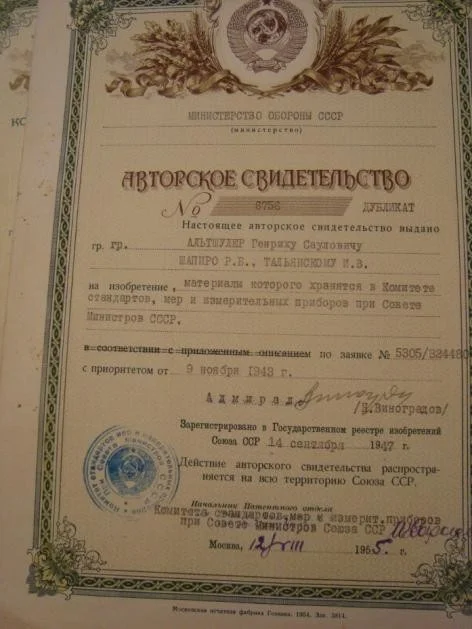
In 1943, Altshuller and Shapiro entered the Azerbaijan Industrial Institute in the Faculty of Oil and Mechanical Engineering. During that same period, they were already working together on technical problems. Their early developments include a breathing apparatus with a chemical cartridge. In the materials on the history of TRIZ, their first Author’s Certificate is associated with an application dated November 9, 1943.
In February 1944, Altshuller volunteered for the Soviet Army from his first year at the institute. He was sent to the 21st Military Aviation School of Initial Pilot Training in Rustavi. In 1945, he ended up in the Inventions Inspectorate of the Caspian Flotilla. There he served as a chemical reconnaissance squad leader in Military Unit 11513, while Shapiro worked as a civilian employee.
The head of the inspectorate was Sergey Yefimovich Smogilev. According to my recollections of Altshuller’s stories, Genrich held him in very high regard—as an intelligent man interested in inventions and a good organizer. Work in the inspectorate provided a steady stream of real technical problems that needed not to be discussed abstractly, but solved and written up as invention applications.
103 Applications and the Turn Toward Researching Inventing
Working in the inspectorate became an important transition from simple inventing to researching the problem-solving process itself. According to TRIZ history materials, Altshuller submitted 103 invention applications and received 103 rejections. For him, this was not merely a disappointment. A question arose: why are some solutions recognized as inventions while others are not? Is it possible to understand in advance in what direction to look for a strong solution?
Altshuller and Shapiro began looking for literature on the methodology of inventing. What they found above all were psychological studies of creativity—descriptions of how different people get ideas, what circumstances accompany insight, and what helps an individual inventor, scientist, writer, or artist. However, such material did not provide a reproducible method.
Then a fundamentally different approach emerged: to proceed not from an inventor’s stories about what he felt at the moment an idea appeared, but backward from an already obtained strong solution to the initial problem. To compare a multitude of solutions, searching for recurring regularities, common transformations, typical conflicts, and ways of eliminating them. This required a large body of patent information.
It is right here that the transition begins which would subsequently lead to the creation of the methodology of inventing, ARIZ, the Inventive Principles, the system of contradictions, and, in a broader sense, TRIZ. Next, this process will be examined in detail—along with the letter to Stalin, the arrest, the camp years, and the return to work on the methodology after release.
Part 2. From the Letter to Stalin and the Camp to the First Open Works on TRIZ
The Letter to Stalin and the Transition from Inventing to Research
By the late 1940s, it was becoming increasingly clear to Altshuller and Shapiro that the problem lay not only in individual unsuccessful applications or shortcomings in patent practice. They were interested in a more general question: why does inventing remain a realm of trial and error, and is it possible to build a method that makes it possible to consciously obtain strong solutions?
They analyzed patent materials, compared problems and solutions, and looked for recurring moves. At the same time, they grew increasingly concerned about the state of inventing in the country. In 1948, Altshuller and Shapiro prepared a lengthy letter to J. V. Stalin. In historical materials, it is described as a letter of about thirty pages, also sent to various state and public organizations and editorial offices. The letter criticized the organization of inventing affairs and proposed measures related, among other things, to the methodology of inventing.
For the history of TRIZ, this episode is important above all because the future theory was already understood at that time not as a collection of isolated successful tricks. The task was framed much more broadly: to change the very organization of inventive work, making it more systematic and teachable.
Arrest. Investigation. Moscow Prisons
July 28, 1950
On July 28, 1950, Genrich Altshuller and Rafail Shapiro were arrested. According to the materials collected for the presentation, the operation was carried out simultaneously in different cities:
Altshuller was arrested in Baku, and Shapiro in Tbilisi, where he had gone on a business trip. Later, both were transferred to Moscow.
The sources available to us name the Lubyanka, Butyrka, and Lefortovo prisons. During this time, Genrich and Rafik did not meet each other. Investigators, prisons, and methods of pressure changed. The investigation lasted several months.
Independent Testimony of Inna Lisnyanskaya
Of special value is the testimony of Inna Lisnyanskaya. In her autobiographical novel “The Boaster” (“Khvastunya”), she recalled “Gena and Rafa” and her own interrogation in connection with their case. The investigation was interested in the young men’s conversations and tried to interpret individual episodes as evidence of anti-Soviet activity.
Lisnyanskaya recalls that she was pressured to confirm a story about a foul-smelling substance that allegedly could have been used during a parade. She was even demanded to confirm the chemical formula of the substance. This testimony is important because it shows that technical or half-joking conversations of young inventors could also be turned into a political accusation.
Lisnyanskaya’s recollections must not be mechanically merged with all of Altshuller’s later accounts. It is an independent testimony of a person who was also interrogated, and for that very reason it should be preserved separately in the text.
Sources: Inna Lisnyanskaya, “The Boaster” (“Khvastunya”), “Znamya” magazine, No. 1, 2006; V. Petrov, “History of the Creation and Development of TRIZ—Text Distribution Across Slides.”
Sleep Deprivation and “The Carafe Story”
In Altshuller’s accounts of the investigation, the system of nighttime interrogations and sleep deprivation is especially memorable. He refused to confess to the charges brought against him and tried to resist not only psychologically, but also rationally—treating it as a problem in which one must find a way to change the conditions.
One of the most characteristic episodes is the story of the carafe. Genrich reasoned as follows: if he struck the investigator, he would be sent to a punishment cell, and there they might finally let him lie down and sleep. However, striking a person directly was psychologically difficult for him. Then he saw a water carafe and decided to use it. When Genrich walked toward the carafe, the investigator probably thought the prisoner wanted a drink and also approached. They grabbed the carafe at the same time and began pulling it toward themselves.
At that moment, a man whom the prisoners called “Malyuta Skuratov” entered the room. Both let go of the carafe. It fell onto the carpet runner; the water spilled out, but the carafe did not break. Altshuller himself later recounted this grim episode with his characteristic irony.
For our history, it is important not to romanticize the investigation here. We are talking about a twenty-three-year-old man who was being deprived of sleep and pressured to confess. Yet even under these conditions, Altshuller’s habitual mode of behavior is noticeable: analyzing the situation, taking constraints into account, looking for a workaround, and using available resources.
The Sentence
On January 13, 1951, the Special Board of the MGB issued its rulings on the case. The materials on Altshuller consistently state a sentence of 25 years in corrective labor camps. Regarding Shapiro, sources diverge: different documents and memoirs contain references to ten and twenty-five years. In the full text, this discrepancy should be preserved rather than replaced with a single convenient version.
After the decision of the Special Board, their paths parted once again. Shapiro ended up in Kazakhstan and Siberia. Altshuller was sent to Vorkuta—to Rechlag, Special Camp No. 6. His camp number was 1-Ch-502.
GULAG. Vorkuta. Rechlag
Beginning of the Camp Period
In Altshuller’s memoirs, this period begins with a very precise time marker: March–April 1951, Vorkuta. He was sent to Rechlag—Special Camp No. 6, created primarily for political prisoners. Vorkutlag and Rechlag existed side by side, but they were different camp structures.
The presentation text cites data showing that as of January 1, 1951, Rechlag held 35,418 people convicted of so-called counter-revolutionary crimes; 23,681 had sentences of over ten years, and 10,639 had sentences of over twenty years. These figures are needed only to understand the scale of the environment in which Altshuller found himself. The main narrative should be built around specific human episodes.
Medical Commission
Before being assigned to work, prisoners underwent a medical examination.
Altshuller honestly told the doctor that he was healthy and nothing hurt. The doctor quietly suggested that he play along and began asking questions about various symptoms. As a result, the medical report recorded that Altshuller could work only on the surface.
I assume this may have saved Genrich: work in the mines was much harder and more dangerous. This is specifically the author’s assessment of the consequences of the episode, not a documented medical conclusion, so this qualification must be preserved in the full text.
The Frozen Log
One of the first camp conflicts was connected with work that Altshuller considered pointless. A prisoner was ordered to pry a frozen log out of the ice with a crowbar. When Genrich was ordered to help, he refused, saying that the work was useless.
The henchmen of the camp’s criminal bosses prepared to beat him. Then Genrich addressed the boss: he already had the maximum sentence—twenty-five years, he had nothing to lose, and if they touched him, he would spend all his strength to settle scores with the offender. In different retellings, the details of the wording vary slightly, but the meaning remains the same: he did not try to win through physical force, which he did not have, but changed the very logic of the conflict.
In one version of the story, he was sent to the punishment cell afterward; in another, it is emphasized that the boss ordered that he not be touched. When reconciling sources, both details require careful coordination rather than a mechanical choice of one version.
“One Thousand and One Nights”
After several refusals to work and stints in the punishment cell, the camp authorities decided to transfer Altshuller to the barracks for common criminals. According to recollections, the calculation was simple: the criminal environment itself would force him to submit. However, Genrich once again chose not to engage in direct confrontation.
When he was brought before the man who held the most power in the barracks, the man asked what he wanted. Genrich replied that he needed nothing, but that he could tell various stories. And he began retelling tales from “One Thousand and One Nights.” The stories were well received. In the conditions of the camp, where there was almost no entertainment, the ability to tell stories became a resource—and changed the attitude toward him.
This story is especially characteristic of Altshuller. He did not try to become physically stronger than men who were obviously stronger than he was. He found another value that he specifically possessed: memory, books, and the ability to tell stories. It is important, however, to perceive this episode specifically as a camp memory, and not as proof of a later theory.
“My Universities”—The Institute of One Student
At the same time, the camp proved to be both a terrible ordeal and an unusual educational environment for Altshuller. Among the prisoners were professors, engineers, specialists, teachers, and people who knew foreign languages. Genrich strove to learn from them. As a result, a peculiar “institute of one student” emerged: the curriculum was determined not by a syllabus, but by what knowledge could be obtained from a specific person.
This was especially important for him because he acutely felt the lack of a fundamental education. Whenever a specialist was nearby, Genrich asked questions, asked for explanations, argued, took notes, and tried to connect the new field with problems he already knew.
Technical Work and Inventions in the Camp
According to recollections, Altshuller gradually managed to transition to technical work.
He worked on problems related to the mine, read specialized literature, and drew upon the knowledge of other prisoners. In one episode, it turned out that a man working alongside him as an assistant was himself the author of a book on the relevant subject and actually possessed qualifications far exceeding his formal camp position.
Altshuller suggested that he take on a more responsible role, but the man was afraid of “sticking his neck out” again, since his past professional activity had been connected with his persecution. For Genrich, this meant that part of the work could be handed over to a more knowledgeable person, while the freed-up time could be used for studying, reflecting on the methodology of inventing, and tackling new problems.
Filkovsky also mentions that Altshuller was entrusted with technical work for camp amateur performances, in particular a revolving stage, and that he later helped the librarian—the poet Moisey Teif. These details should be preserved with an indication of the specific memoir source.
The Vorkuta Uprising of 1953
In 1953, a major prisoner uprising took place in the Vorkuta camp system. In the full biographical text, this historical background is necessary because it helps explain the situation during Altshuller’s final camp years. However, Genrich’s own participation in specific episodes of the uprising must not be expanded beyond what is directly confirmed by his accounts or other sources.
Therefore, here we record the event as part of the environment of Rechlag and Vorkuta and do not attribute actions to Altshuller that the submitted materials do not directly confirm.
Release and Rehabilitation
In 1954, a review of the case began. According to Leonid Filkovsky’s account of the procedure in Tbilisi and of Altshuller’s firm stance, he refused to agree to a simple reduction of his sentence and insisted on recognition that the charges were unlawful.
On October 22, 1954, Altshuller was rehabilitated. After the camp, he returned to normal life and work. For our history, it is fundamentally important that his research into the methodology of inventing was not abandoned. On the contrary, after his release, the transition to the open publication of results began.
1956—The First Open Methodology of Inventing
“On the Psychology of Inventive Creativity”
In 1956, the journal “Voprosy Psikhologii” (“Problems of Psychology”) published an article by G. S. Altshuller and R. B. Shapiro titled “On the Psychology of Inventive Creativity.” This was the first open publication of the methodology, which in our historical scheme I call ARIZ-56. The year 2026 marks the 70th anniversary of this publication.
The problem-solving sequence was divided into three stages: analytical, operative, and synthetic. The 1956 version had ten steps and five principles, some of which were still analogues of future tools. It is very important not to attribute the later structure of ARIZ to this version. What we have before us is specifically an early methodology—still compact, yet already step-by-step.
Here a fundamental premise already appears: a solution should not be a random flash of insight, but an organized process. The problem is analyzed, changes are then systematically examined, and finally the obtained solution and its consequences are verified.
First Precursors to the Laws of Systems Evolution
The 1956 article contained more than just problem-solving steps. Observations on the evolution of technical systems were already formulated there: the elements of a machine, mechanism, or process are closely interconnected; the development of individual parts proceeds unevenly; changing one element may require changing others. This is not yet a complete system of laws of technical systems evolution, but these are important precursors to the future direction of research.
Therefore, 1956 is simultaneously the beginning of the open history of ARIZ and one of the early stages in forming ideas about the patterns of technical evolution.
Source: G. S. Altshuller, R. B. Shapiro, “On the Psychology of Inventive Creativity.”
Gas and Thermal Protective Suit
In 1956, Altshuller and Shapiro filed an application for one of their best-known joint inventions—an apparatus for individual gas and thermal protection. The application was filed on July 24, 1956; later, Author’s Certificate No. 111144 was issued.
This episode is regarded as the culmination of their joint inventive line. The solution involved strict constraints on weight and operating duration. Later, it was precisely such problems that Altshuller used as material for reflecting on the method.
Sources: Author’s Certificate No. 111144.
1958–1960—Testing and Development of the Methodology

After the 1956 publication, work on the methodology did not stop. Altshuller conducted seminars, continued analyzing inventions, wrote technical articles, and at the same time became increasingly active in science fiction. It was this combination of theory, practical problem solving, teaching, and literary work that became the defining feature of this period.
In 1958, a seminar on the methodology of inventing was held in Baku at the Ministry of Construction of Azerbaijan, attended by 22 engineers and technicians. In TRIZ history materials, this seminar is associated with a clearer formulation of the concept of the Ideal Final Result.
At the same time, articles on inventing and patent law, technical publications, and his first science fiction stories were coming out. For Altshuller, science fiction was gradually becoming not only literature, but also material for investigating future technical ideas.
1959—ARIZ-59
In 1959, Altshuller and Shapiro published the article “Expulsion of the Six-Winged Seraph.” It presented the next version of the methodology, which I call ARIZ-59. The three stages—analytical, operative, and synthetic—were retained, but the logic of problem solving itself became substantially more developed.
In the analytical stage, a fundamentally important step appeared—envisioning the Ideal Final Result. After that, one determines what prevents achieving this result, identifies the contradiction, and establishes the conditions under which it can be eliminated. As a result, a problem begins to be examined not only forward from the existing situation toward possible changes, but also backward from the image of the required result to the obstacle.
ARIZ-59 already contained fifteen steps and eighteen principles. In the operative stage, the search for changes in the object, the external environment, and neighboring objects was expanded. In the synthetic stage, transferring the found solution to connected elements of the system was refined.
Thus, what took place between 1956 and 1959 was not cosmetic editing, but a substantial development of the structure of the method itself. This is an important regularity throughout the entire history of ARIZ: Altshuller constantly tested the algorithm on problems, changed steps, introduced new concepts, and removed whatever he considered insufficiently effective.
1960—Attempt to Transfer the Methodological Approach to Scientific Discoveries
In 1960, Altshuller prepared the work “How Discoveries Are Made: Thoughts on the Methodology of Scientific Work.” This direction is particularly interesting because it shows that even at an early stage, his interest was not limited solely to engineering inventions. He was trying to understand whether regular principles could also be identified in scientific research.
At the same time, his literary work continued. Science fiction stories and novellas were published, including “The Bogatyr Symphony,” “The Fiery Flower,” “Ballad of the Stars,” and others. This line would later lead to a systematic study of science fiction and the development of the RTV (Creative Imagination Development) course.
1961—The First Book on TRIZ
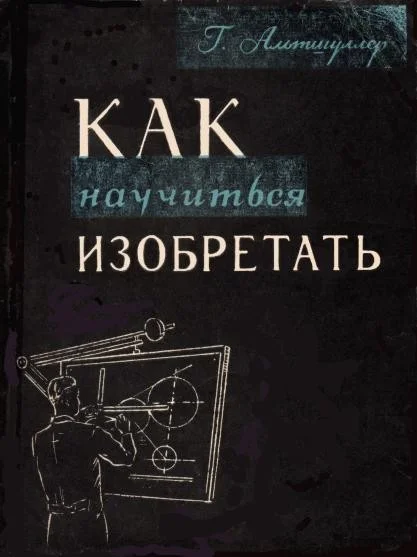
In 1961, Altshuller’s first book, “How to Learn to Invent,” was published in Tambov. This was no longer a journal article, but a standalone book designed as a systematic exposition of the method. It presented the ARIZ-61 version and significantly expanded the instructional material.
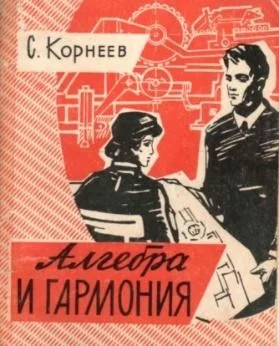
The publication of this book was connected with Tambov and the editorial support of Stanislav Georgievich Korneev. In the history of TRIZ, his role is important not only as an editor. He helped publish the first books and brochures, and then became fascinated with the methodology of inventing himself and published materials on the subject.
Almost simultaneously, Rafail Shapiro, under the pen name Rafail Bakhtamov, published the book “Expulsion of the Six-Winged Seraph,” which gave a popular account of Altshuller’s methodology. Thus, the theory began spreading through two channels at once: through Altshuller’s own methodological texts and through Shapiro’s popular-science exposition.
What Changed in ARIZ-61
ARIZ-61 retained three stages, but already contained sixteen steps and twenty-two principles.
In the operative stage, an additional step appeared—checking the possibility of dividing the object into independent parts. The number of problem-solving tools increased, and the methodology gradually evolved from a brief outline into a more developed instrument.
Historically, it is important not to confuse this version with later versions of ARIZ. In 1961, the structure that most specialists are accustomed to associating with ARIZ-77 or ARIZ-85 did not yet exist. Each version must be viewed as a distinct stage of development.
Books, Seminars, and the Beginning of a School
In 1961–1962, teaching expanded. Seminars were held in various cities, and the number of people becoming acquainted with the methodology grew rapidly. In “THE HISTORY OF TRIZ DEVELOPMENT,” it is noted that in 1962 Altshuller conducted more than thirty training seminars in Ryazan, Penza, Stavropol, Moscow, and other cities.
Here begins the transition from individual development of a method to the formation of a school.
For a theory to exist, it is not enough for its author to know how to solve problems himself. One must create instructional materials, train teachers, and build a system for testing and developing new ideas. This very line would become one of the main ones in the years that followed.
The Beginning of Development: 1961–1964

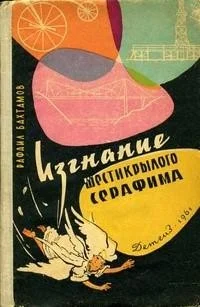

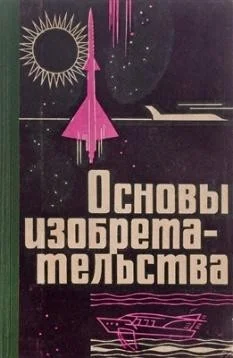
I regard the period of 1961–1964 as the beginning of systematic development. Prior to this, the main task had been creating and testing the first variants of the methodology. Now several directions were developing simultaneously: problem-solving methodology, Inventive Principles, teaching, publications, science fiction, attempts to formulate regularities of technical evolution, and the future course on Creative Imagination Development.
In 1962, the brochure “Ten Percent of Adventures” was published. In 1963, a more systematic study of science fiction as a source of ideas and material for developing imagination began. In 1964, the book “Foundations of Inventing” and the ARIZ-64 version appeared. It introduced a new part—verifying and clarifying problem conditions—and the principles began to be organized more systematically.
In the 1964 materials, the phrase “algorithm for inventive problem solving” appeared. It is important to distinguish between the appearance of the full phrase and the later established use of the abbreviation ARIZ: according to research on the history of the algorithm, the abbreviation appeared in 1968, and in print in 1969.
By this time, Altshuller also began compiling the first version of the “Register of Modern Science Fiction Ideas”—the future “patent fund” of science fiction. This was yet another line that would later be connected with RTV and forecasting research.
What Had Already Taken Shape by 1964
If we look at this period as a whole, several interconnected directions already existed by the mid-1960s. There was a step-by-step methodology for solving inventive problems that was constantly evolving. There was a growing set of principles for resolving contradictions.
There were initial ideas about the patterns of technical systems evolution. There were teaching and seminars. There were books, journal articles, and popularization. There was research into science fiction. In other words, what was emerging was no longer an isolated methodology, but the embryo of a system.
However, the name “TRIZ” should not yet be automatically projected onto every early document. In a historical text, it is important to preserve the terminology of the respective period:
“methodology of inventing,” “theory of inventing,” “algorithm for inventive problem solving.” The later name is convenient for a general narrative, but it must not obscure the evolution of concepts.
The next part should continue this line: ARIZ-65 and ARIZ-68, the development of the principles and the matrix, the first teacher training schools, Dzintari in 1968, the further formation of the TRIZ movement, Su-Field analysis, the Standards, and the major seminars of the 1970s.
Part 3. 1964–1974
1964. From the Methodology of Inventing to the Algorithm
The year 1964 was an important milestone. By this time, several successive variants of the methodology for solving inventive problems already existed. Now, not only was the detailing of individual steps changing—a conception of the algorithm as a holistic sequence for solving a difficult inventive problem was gradually taking shape.
In Genrich Altshuller’s book “Foundations of Inventing,” published in 1964, the term “theory of inventing” was used for the first time. Simultaneously, the methodology for problem analysis was developed, and the concepts of the Ideal Final Result, contradiction, bypass problem, principles, and the system for selecting principles were refined.
ARIZ-64 consisted of four stages: selecting the problem, analyzing the problem, the operative stage, and the synthetic stage. It had 18 steps, 31 basic principles, 16 universal parameters, and a 16×16 table. Especially important is the terminological transition: it was in 1964 that the name “algorithm for inventive problem solving” appeared.
S. G. Korneev and Tambov
Stanislav Georgievich Korneev holds a special place in the history of the dissemination of the early methodology. In 1964, his brochure setting forth Altshuller’s theory and the methodology for conducting classes was published in Tambov. It provided a lesson-by-lesson seminar curriculum and examined the “ideal machine,” certain regularities of technical evolution, forecasting of future machines, and a step-by-step algorithm for solving inventive problems.
For the history of ARIZ, this source is particularly important: the appendix to Korneev’s work records the variant that I designate as ARIZ-64. It is here that the 31 principles and the table with 16 universal parameters are presented.
Science Fiction as Research Material
In parallel, Altshuller continued working with science fiction not only as a writer, but also as a researcher. In 1964, the first version of the “Register of Modern Science Fiction Ideas” appeared—a kind of patent fund of science fiction ideas. The goal was not to collect unusual plots, but to systematize ideas and identify directions in which science fiction outpaces real technology.
This line would subsequently become one of the foundations of the course on Creative Imagination Development—RTV. Later on, the register would expand, and the analysis of science fiction would lead to new principles and methods for developing imagination.
“The Griada Crocodile”
An unusual episode in Altshuller’s literary activity dates to this same period—the story of “The Griada Crocodile.” I include it not as a retelling of an internet publication, but as an independent episode in Altshuller’s history, preserving the facts and separating them from the later literary form of the story.
In Moscow, Altshuller became acquainted with a science fiction fans’ club at the House of Children’s Books. The teenagers, who knew science fiction intimately, had a very harsh attitude toward weak and derivative works. The conversation gradually led to the idea of a kind of anti-award—a prize for the worst science fiction work of the year.
The name arose from two independent stories. The first was connected with Georgy Kolpakov’s novel “Griada” and criticism of its borrowings. The second involved crocodile figurines produced by “Krokodil” magazine for its anniversary and subsequently sold off at a discounted price. Out of these two lines emerged “The Griada Crocodile.”
Rules for the prize were formulated, and the awarding procedure and the form of the trophy itself were defined. Named as one of the first works selected by the club was “Fall of a Supernova” by Mikhail Yemtsev and Yeremey Parnov. For me, this episode is also important because it shows a transition characteristic of Altshuller from isolated criticism to creating a procedure: not merely saying that a work is bad, but devising a sustainable mechanism for public feedback.
1965–1967. Refinement and Development
ARIZ-65 largely continued the logic of the previous version. No major structural changes occurred compared to ARIZ-63 and ARIZ-64; the table was refined, wordings were edited, and new cells were filled in. This is an important point: development proceeded not only through the emergence of major new ideas, but also through long-term testing of an already created tool.
At the same time, the development of principles for resolving technical contradictions continued.
Researching the patent fund yielded more and more material, and sub-principles and the search apparatus were refined. The principles gradually evolved from a set of heuristic hints into a systematized information fund.
1968. ARIZ-68 and the Transition to Mass Training
ARIZ-68 already differs noticeably from previous variants. It included five stages: selecting the problem, clarifying the problem conditions, analytical, operative, and synthetic. In total—25 steps, 35 principles, 32 universal parameters, and a 32×32 table. In the stage of clarifying conditions, prototypes of the future STC (Size-Time-Cost) operator appeared. It was in this version that the abbreviation ARIZ appeared; it would become established in print in 1969.
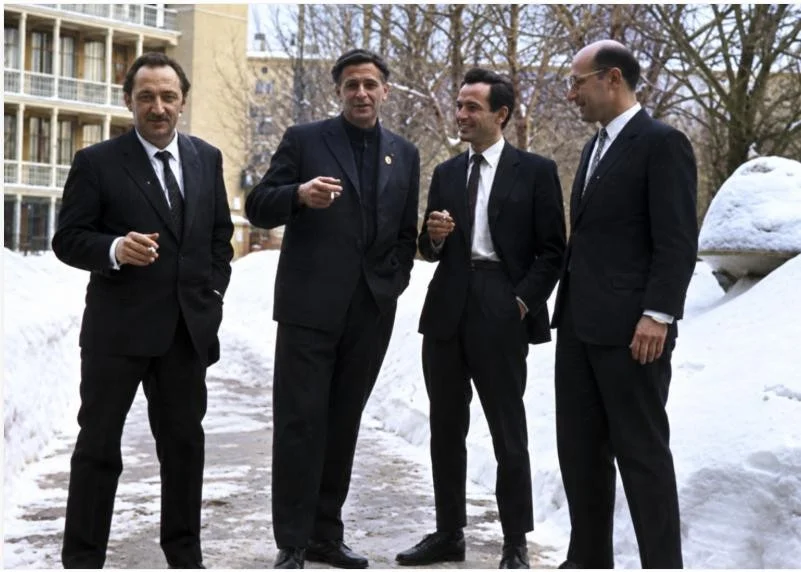
First Seminar for Teachers. Dzintari, 1968
The year 1968 is important for another reason as well. The Central Council of VOIR organized the first seminar for training teachers of inventive methodology in Dzintari. Prior to this, Altshuller had taught the methodology himself for many years. Now the task became different: to train people capable of independently conducting instruction in other cities.
Thus begins the transition from an author’s course to a school of teachers and researchers.
Following Dzintari, seminars and schools appeared in other cities. TRIZ gradually ceased to be solely Altshuller’s Baku center of work.
Source: “History of the Creation and Development of TRIZ—Text Distribution Across Slides”; V. Petrov, “History of TRIZ Development.”
Science Fiction and “Scorching Mind”
In 1968, Altshuller’s literary line also continued. Genrich Altov’s collection “Scorching Mind” (“Opalyayushchiy razum”) was published. For him, science fiction remained an independent realm of creativity and simultaneously material for investigating the regularities of imagination.
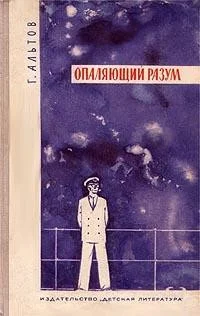
“Evrotron”—A Mechanical Machine for Teaching Problem Solving
Dating to the late 1960s is an experiment with a mechanical machine called the “Evrotron.” It is important not to exaggerate its capabilities: it was not a machine capable of inventing on its own. It was used as a training device that helped users work with the table of principles and the steps of the algorithm.
Materials about the “Evrotron” describe a system of signals—red, yellow, and green.
The device was meant to discipline the search process and visually display the sequence of work. For the history of TRIZ, this is an early example of an attempt to partially externalize the algorithmic problem-solving procedure into an external device.
Source: Presentation materials; V. Zhuravleva, “From ‘Pharmakon’ to Science Fiction,” 2003—source cited in the working text of the presentation.

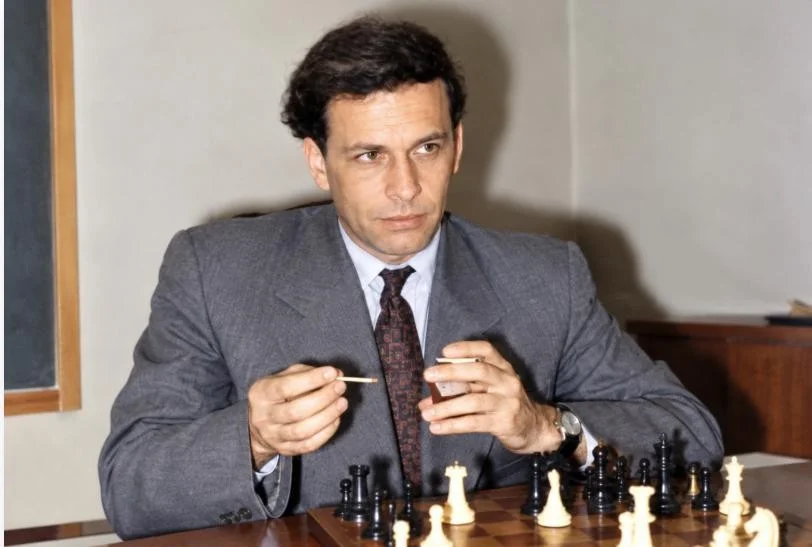
Chess—A Separate Photograph
The next photograph in the presentation does not relate to the “Evrotron.” In it, Altshuller is playing chess. It is important to keep this separate so as not to create a false connection between the images.
Source: Presentation “The History of TRIZ”; clarification by V. Petrov.
1969. “The Innovation Algorithm”
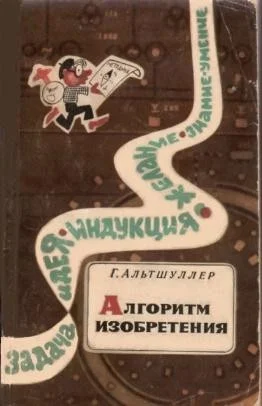
In 1969, the book “The Innovation Algorithm” (“Algoritm izobreteniya”) was published. By this time, a much more integrated system had taken shape: ARIZ, the principles, the table, the Ideal Final Result, technical contradiction, elements of analyzing the evolution of technical systems, and work with physical effects.
In parallel, the first TRIZ schools appeared in various cities, and systematic work began on an index of physical effects. Thus, not just one tool was developing, but several interconnected subsystems of the future TRIZ at once.
1970–1974. Formation of the TRIZ School
In the early 1970s, TRIZ entered a new period. Simply refining the algorithm was no longer enough. It was necessary to create training courses, train teachers, develop reference funds, and organize a regular exchange of materials between cities.
In 1971, ARIZ-71 appeared. Its structure became significantly more complex: six parts, a separate preliminary evaluation of the found idea, and a developed operative part. This was no longer the brief methodology of the 1950s, but a branching instrument for analyzing and solving difficult problems.
AzOIIT and Instructional Materials
A large body of instructional and methodological materials was created in Baku. According to participants’ recollections, by the early 1970s a set of training materials could run to hundreds of pages. These materials were regularly mailed out to teachers and schools in different cities.
A network of people emerged who no longer merely read Altshuller’s books, but worked according to a unified curriculum and exchanged developments.
It was into this system that I entered in 1972 after reading the article “Dare, You Are Talented!” and becoming acquainted with the book “The Innovation Algorithm.” I wrote to OLMI and soon received instructional materials from Baku along with an offer of correspondence study at the Azerbaijan Public Institute of Inventive Creativity. The program was designed for two years, but I completed it much faster, corresponding constantly with Genrich Saulovich.
1973. Physical Effects and Su-Field Analysis
In 1973, Yury Gorin prepared an index of physical effects and phenomena. This was an important development of the information fund: physical effects became not merely reference material, but a targeted tool for searching for a solution.
The emergence of Su-Field (Substance-Field) analysis dates to this same period. In TRIZ history materials, 1973 is marked as the beginning of this line. In 1974, a separate work by Altshuller, “On Su-Field Analysis,” was published. Later, Su-Field analysis would become one of the basic languages for modeling problems in TRIZ.
Nina Petrovna Linkova
Nina Petrovna Linkova played a major role in organizing the movement. In the presentation, next to her photograph, there is a recollection of a difficult conversation with V. N. Tyurin, Secretary of the Central Council of VOIR, regarding the need to create OLMI. In the history of TRIZ, Linkova figures not as a casual participant, but as one of the people who provided the organizational foundation for the work.

Gorky, 1974. The Conference
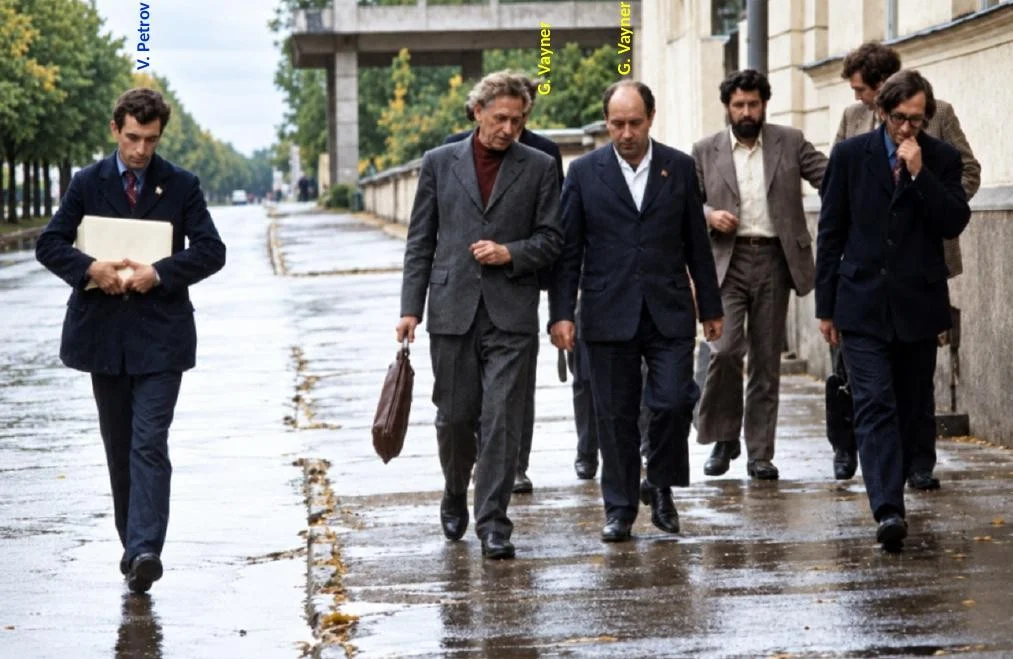
In 1974, a conference took place in Gorky—now Nizhny Novgorod. For me, this is no longer history known only from documents: I was a participant in these events.
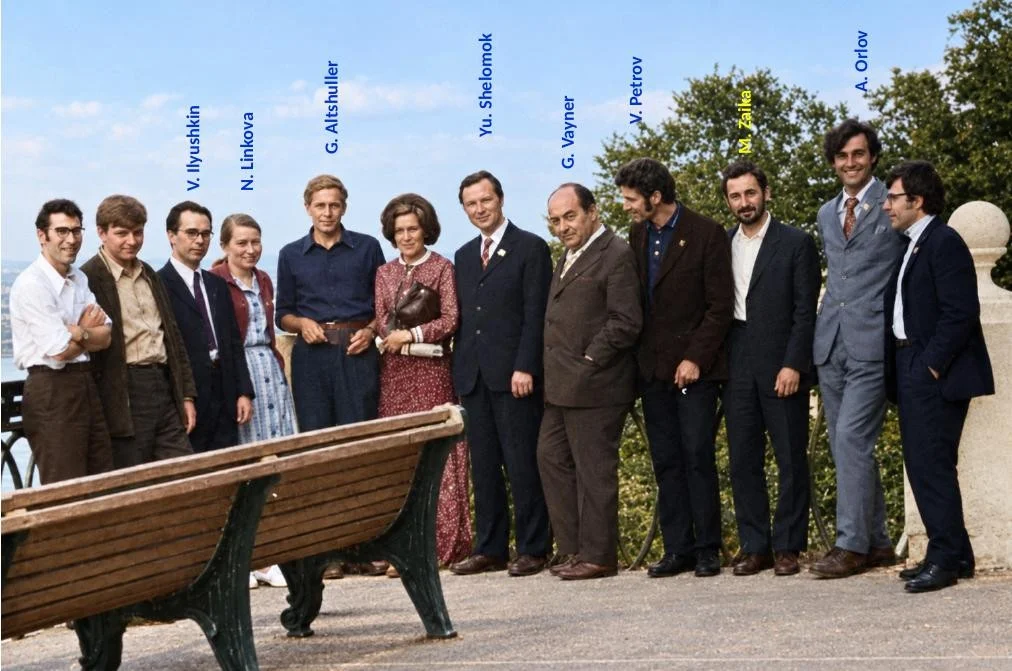
After the first day of the conference, we were returning to the hotel. Altshuller had handed out materials to the participants. I had not brought a bag with me and therefore carried the received materials in my hands. In the photograph, Altshuller is talking with Grigory Vainer. This snapshot is important precisely as a candid photograph of working communication—not an official staged pose, but an ordinary moment after a busy day.
Source: Personal recollections of V. Petrov; presentation “The History of TRIZ.”
In the next photograph is the certification commission: Genrich Altshuller, Nina Linkova, and E. Kashin, Secretary of the Central Council of VOIR. Certifying teachers was a crucial part of the transition from an informal circle of like-minded enthusiasts to a system for training and qualifying TRIZ instructors.

After the conference ended, a group photograph was taken on the Volga. According to the presentation captions, the photograph shows the conference participants, including G. S. Altshuller, N. Linkova, Yu. Shelomok, G. Vainer, V. Petrov, and others.
Source: Presentation “The History of TRIZ”; personal recollections of V. Petrov.
Moscow, “Eureka,” 1974
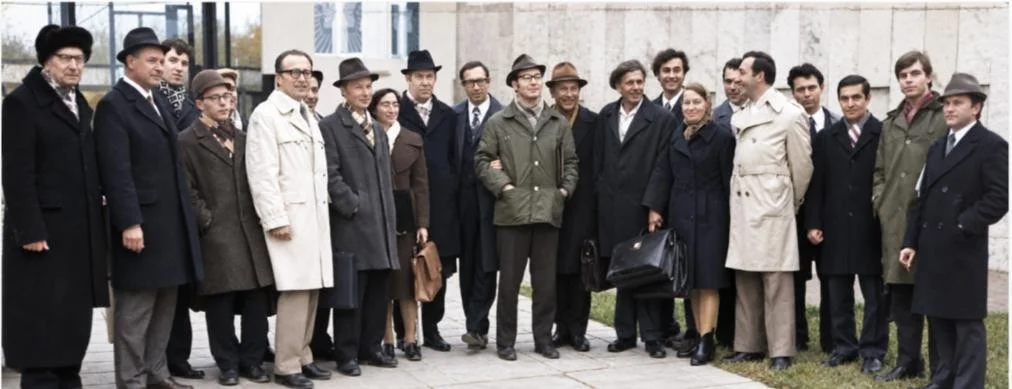
In 1974, the “Eureka” (“Evrika”) meeting took place in Moscow at VDNKh, at the Central Council of VOIR. Among the participants were Genrich Altshuller, Alexander Selyutsky, Volyuslav Mitrofanov, Yury Shelomok, Boris Goldovsky, and Vladimir Petrov. According to my recollections, Nina Linkova was not included in this meeting. This episode clearly shows that by the mid-1970s, a circle of teachers and developers was already forming that would shape the further development of TRIZ.
Development of RTV in 1974
In 1974, Altshuller continued developing the course on Creative Imagination Development (RTV). Appearing in the materials of this period are “Development of Systemic Thinking”—the future nine-screen scheme—along with “Phantograms,” the Method of Little People, and other tools. This demonstrates once again that TRIZ developed not only as an algorithm for solving technical problems.
Altshuller was interested in a broader task—developing strong, controllable creative thinking.
What Had Taken Shape by the Mid-1970s
If we look at the period of 1964–1974 as a whole, a qualitative change in the scale of the system is evident. In 1964, it was still a matter of developing a methodology and turning it into an algorithm. Ten years later, a TRIZ school already existed: ARIZ, the system of principles and tables, work with physical effects, Su-Field analysis, RTV, training curricula, teachers in different cities, conferences, OLMI, and a regular exchange of materials.
In other words, TRIZ ceased to be solely the result of one author’s work. Genrich Saulovich remained the central figure and chief developer, but a community of teachers and researchers formed around him. It was precisely this that created the foundation for the next stage—the development of the Standards, the further evolution of ARIZ, and the intensive work of the second half of the 1970s.
Part 4. 1975–1982
1975–1977. Physical Contradiction Becomes a Working Tool
In the mid-1970s, the development of TRIZ proceeded along several lines simultaneously. The structure of ARIZ was refined, work with the Physical Contradiction was strengthened, Inventive Standards appeared, and the Su-Field apparatus expanded. For me, it is important to view these lines not separately, but as interconnected parts of an overall system.
A Technical Contradiction shows that an attempt to improve one characteristic of a system leads to the deterioration of another. A Physical Contradiction makes the conflict more specific: opposite requirements are placed upon the very same object, its part, or its zone.
An object must possess one property to perform one necessary action and the opposite property to perform another.
In ARIZ-71B, which I date to 1975, a dedicated step for formulating the Physical Contradiction appeared. Simultaneously, the problem model was developed, the System Operator and Su-Field notation of conditions were used, and Su-Field transformations were provided for. In ARIZ-71V, also from 1975, the problem model was refined, and full and brief formulations of the Physical Contradiction along with its diagram were introduced. Recording the problem conditions in Su-Field form was singled out as a standalone step.
In 1976, Altshuller worked specifically on formalizing the formulation of a Physical Contradiction. In 1977, ARIZ-77 appeared, in which the Physical Contradiction line became even more developed and was linked to the transition to micro-level analysis.
1975. The First Five Standards
In 1975, Genrich Saulovich Altshuller developed the first five Standards for Inventive Problem Solving. This was a new type of tool. A Standard was meant to apply not to a single specific problem, but to a sufficiently broad class of problems for which a consistent method of transforming the system could be formulated.
The first work on the Standards was simultaneously theoretical and instructional material.
For each Standard, a formula, explanations, examples, and necessary and sufficient conditions for application were given. At the end, problems and exercises with control answers were included. Thus, from the outset a Standard was created not only as a research result, but also as a training tool.
For the history of TRIZ, this is fundamental. While Inventive Principles indicate a search direction, Standards strive to make solving specific classes of problems much more unambiguous and reproducible. Later, an entire system would be built out of individual Standards.
1976–1978. From Individual Standards to a Growing System
In 1976, Standards 6–9 appeared. They were developed according to the same general scheme as the first five. In late 1976–early 1977, the tenth Standard appeared. In 1977, Standard No. 11 was developed. Thus, over two years the number of Standards increased from five to eleven.
In 1978, the number of Standards rose to eighteen. Yet what mattered was not only the quantity.
Formulations were refined, the scope of applicability expanded, and new ways of building Substance-Field structures emerged. Appearing in the materials of this period is the concept of a complex Fe-Field, along with refined Standards related to resonance, motion control, and transitions between physical states.
I was involved in analyzing the Standards practically from the moment they appeared. Brief reference guides were compiled for students, and materials analyzing changes, offering remarks, and outlining possible directions of development were prepared for instructors. Even then, it was becoming clear that the Standards could be used not only for solving problems, but also for investigating trends in the evolution of technical systems.
Source: V. Petrov, “Emergence and Development of the System of Standards,” appendices and comparative analysis of the 1975–1978 modifications; “Polygenius.”
1978–1980. Expansion of TRIZ Tools
By the late 1970s, TRIZ could no longer be described solely through ARIZ and the Inventive Principles. Developing in parallel were indices of physical effects, the Standards, Su-Field analysis, the laws of technical systems evolution, resources, process analysis, methods of Creative Imagination Development, and teaching methods.
In 1978, the second index of physical effects appeared, containing around four hundred effects. Process analysis, materials on joinability, the system of laws of technical systems evolution, applicability theory, and resources were being developed. Boris Goldovsky and his colleagues continued working on the “Comprehensive Method.” At the same time, experience in teaching TRIZ within continuing education and vocational-technical education systems was accumulating.
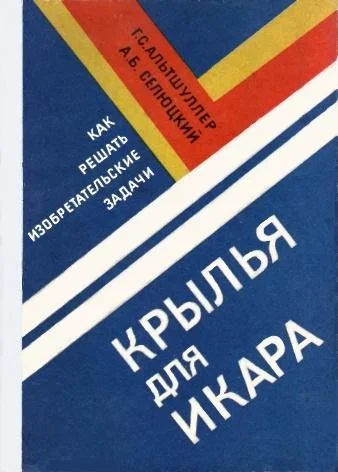
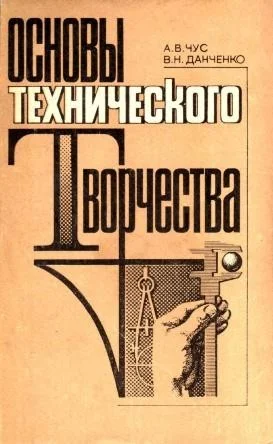
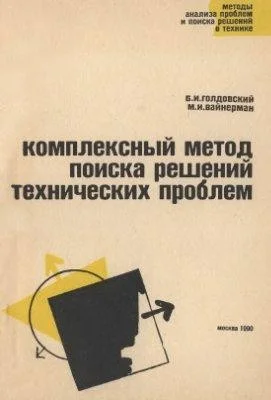
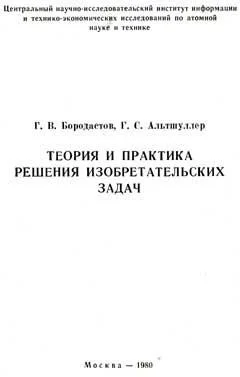
1979. “Creativity as an Exact Science” and the System of 28 Standards
In 1979, Genrich Saulovich’s book “Creativity as an Exact Science” was published. The title itself very accurately expresses the direction of all of Altshuller’s many years of work: creativity is viewed not as inscrutable inspiration, but as an activity in which one can identify regularities, build tools, and teach a person powerful problem-solving methods.
In March 1979, Altshuller created a system of 28 Standards. This was already a qualitatively different stage. The Su-Field approach became the primary basis for classification. The Standards were grouped into categories: changing systems, detection and measurement, and applying the Standards. One of the Standards in this system was proposed by Volyuslav Mitrofanov.
Here one can see especially clearly how the very logic of TRIZ development changes. First, individual rules for solving typical problems appear. Then there become enough of them that a system is required. And once the system appears, it becomes possible to investigate not just individual Standards, but the regularities governing the evolution of the system of Standards itself.
1980–1982. From the System of 28 Standards to the Systems of 50 and 54 Standards
The next major step was taken in 1981, when the system of 50 Standards appeared.
The previous continuous numbering disappeared. A Standard’s number now reflected its place in the structure: class, subclass, and specific Standard. The system became much more logical and convenient for further development.
In 1982, the system expanded to 54 Standards. Thus, within a few years the path had progressed from five individual Standards in 1975 to a large multilevel system. Later its development would continue: 59, 60, 69, and finally 76 Standards.
This growth cannot be understood merely as a mechanical increase in the number of rules. The structure changed, new classes and subclasses were introduced, and links with Su-Field analysis, physical effects, and the evolution of technical systems were refined.
The Leningrad School of TRIZ
By the late 1970s, Leningrad had become one of the most active centers of TRIZ. City seminars were held there, a University of the Inventor and Rationalizer operated, the combined use of TRIZ and Value Engineering (Functional-Cost Analysis) developed, and instructors and developers produced their own research.
For me, this period is particularly important because the history of TRIZ increasingly became a history of collective work. Materials were constantly shared between cities. We discussed new versions of ARIZ, Standards, Su-Fields, physical effects, laws of systems evolution, and RTV methods. Altshuller carefully read new developments, criticized them, accepted strong ideas, and demanded rigorous justification.


In the group photograph at the table, sitting with his back to the photographer is Genrich Saulovich. To his right is his son Yevgeny. Next, part of Volyuslav Mitrofanov’s head is visible, followed by Semyon Litvin, R. Englin, V. Gerasimov, V. Kryachko, and E. Zlotina. To the left of Altshuller is me.
Petrozavodsk, 1980. The First Special Seminar of TRIZ Developers
In the summer of 1980, the first special seminar of TRIZ teachers and developers was held in Petrozavodsk. For me, this is one of the most important milestones. It was no longer an ordinary training course where students master a ready-made theory. Participants arrived with their own developments, which were to be discussed as possible directions for the further evolution of TRIZ itself.
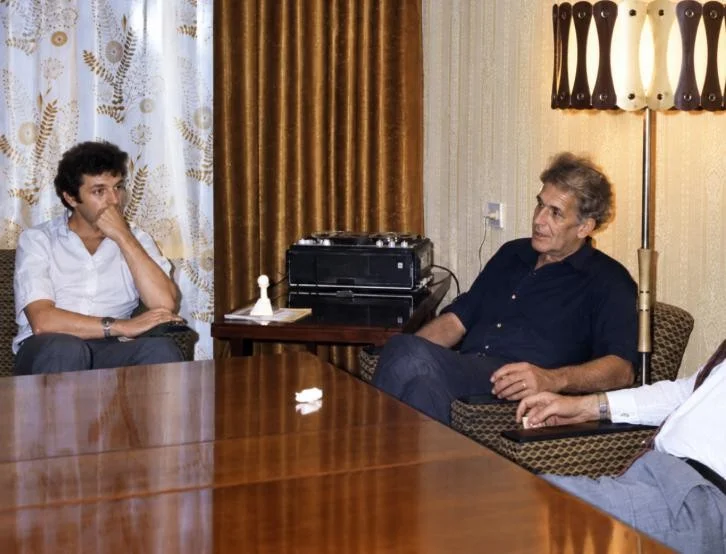
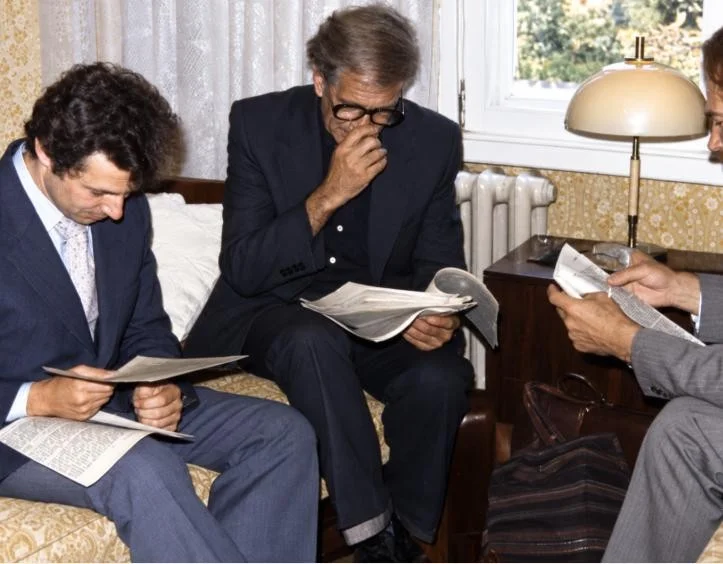
Work actually began even before the general session. We had just arrived. I was in the room shared by Volyuslav Mitrofanov and me. I was sitting on my bed, Genrich Saulovich sat down next to me, and Mitrofanov was sitting on his bed. Right away, we began reading the materials brought by the participants and discussing them.
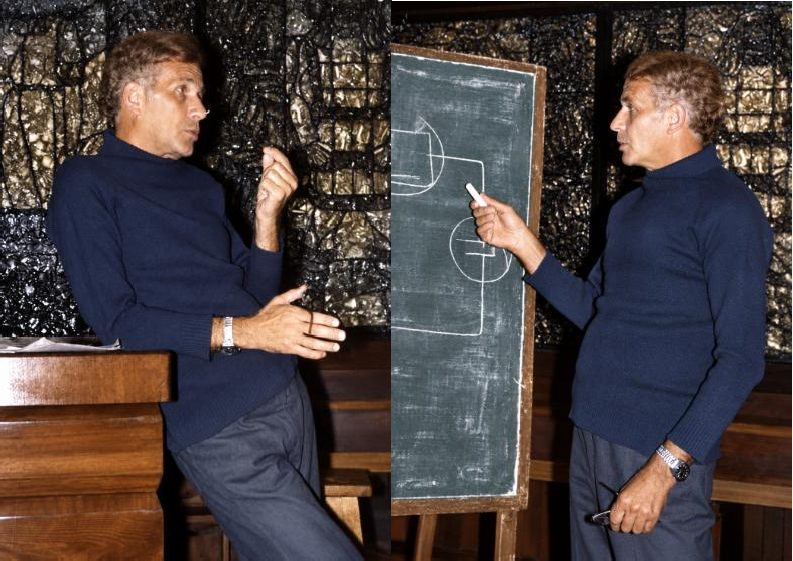
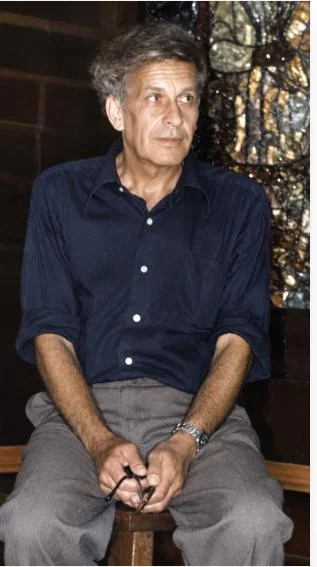
According to my recollections, there were about twenty people at the seminar. Boris Goldovsky presented the “Comprehensive Method.” Boris Zlotin presented process analysis. Semyon Litvin presented materials on RTV. I presented systems analysis, which I viewed as a possible part of ARIZ. Genrich Saulovich examined the works very carefully and often criticized them sharply.
Boris Zlotin’s materials preserve a reference to three days of extraordinarily intensive discussions followed by a lengthy transcription of tape recordings. For one of the central case analyses—the problem of a thermal bimetallic circuit breaker—the attendance of 18 people is recorded. Therefore, the number 18 refers to a specific discussion and should not automatically be taken as the exact total number of seminar participants.
1982. ARIZ-82 and Further Development of the Algorithm
By the early 1980s, ARIZ had become a much more complex and rigorous instrument. In 1982, ARIZ-82 and the subsequent variants ARIZ-82A, 82B, 82V, and 82G appeared. They further developed the analysis of the problem model, work with the operative zone and operative time, Substance-Field Resources, Standards, and Physical Contradictions.
It is important to remember that ARIZ was never a once-and-for-all finished instruction manual. For nearly thirty years, Altshuller constantly restructured it. Parts, steps, formulations, and information support changed. Each new variant reflected accumulated problem-solving experience and the development of TRIZ as a whole.
Source: V. Petrov, “History of the Development of the Algorithm for Inventive Problem Solving—ARIZ,” comparative analysis of ARIZ modifications.
Sverdlovsk, 1982. Altshuller’s Seminar
In 1982, a major seminar led by Genrich Saulovich took place in Sverdlovsk. For me, this seminar holds special significance: Genrich Saulovich was the main instructor, and I was the second instructor. Working alongside us were trainee instructors who conducted individual parts of the sessions.
Yury Salamatov, who participated as a trainee instructor, later wrote directly:
“The second instructor, alongside G. S., was V. Petrov.” Igor Kondrakov presented materials on the laws of technical systems evolution.
My responsibilities included, above all, checking homework assignments, as well as lecturing on specific sections of the curriculum and analyzing problems. There were about fifty people at the seminar.
Each day, attendees received at least three assignments. The first was to solve a problem using ARIZ, working sequentially through all the steps. The second involved working with science fiction and evaluating sci-fi ideas. The third assignment varied and could involve methods for activating the creative process. This amounted to up to one hundred and fifty papers a day that had to be reviewed and analyzed.
Altshuller’s seminars were not readings of prepared lectures. Attendees argued, proposed solutions, and asked uncomfortable questions. Sometimes they challenged the very possibility of algorithmizing inventing. Altshuller responded not with general declarations, but with problems, analysis, and results. Therefore, a seminar was simultaneously both training and a test of the viability of TRIZ.
Leningrad, 1982. Closure of the City Seminar
In 1982, an episode occurred in Leningrad that I remember well. A regular city TRIZ seminar was scheduled to take place. Participants arrived at the Radio Polytechnic School, where classes were traditionally held, and found locked doors. Posted on them was a notice canceling the seminar.
This happened after the newspaper “Komsomolskaya Pravda” published an article titled “Pretensions” (“Pretenzii”) on December 11, 1982. Here I deliberately speak only of the chronological sequence: there was the publication, and then the closure of the seminar followed. The coincidence itself was very striking to us, but turning it into a proven direct causal link without additional documents would be incorrect.
The story had an almost symbolic continuation. The seminar took place after all—at the club of the “Komsomolskaya Pravda” Factory. By that time, TRIZ already existed in many cities, and there were far too many teachers, researchers, and students for its development to be halted by closing a single lecture hall.
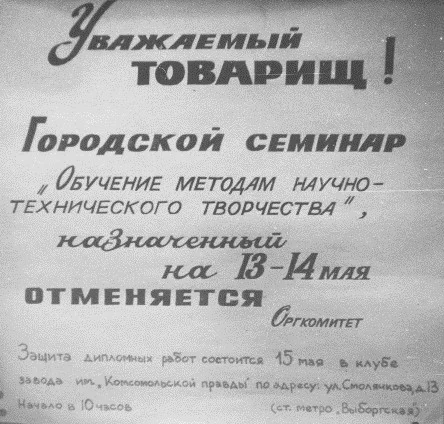
Dear Comrade! The city seminar “Training in Methods of Scientific and Technical Creativity” scheduled for May 13–14 HAS BEEN CANCELLED Organizing Committee Diploma project presentations will take place on May 15 at the club of the ”Komsomolskaya Pravda” Factory, 13 Smolyachkova Street (Vyborgskaya metro station). Starts at 10:00 a.m.
What Had Changed by 1982
If we compare the early 1970s with 1982, a qualitative change in the scale of TRIZ is evident. At the beginning of the decade, there were ARIZ, the table of principles, the first schools, and individual training materials. By 1982, major seminars were operating in various cities, strong regional schools and a circle of developers had formed, a system of Standards existed, and the laws of technical systems, physical effects, RTV, Su-Field analysis, and several directions for the further development of ARIZ were advancing.
This was a transition from a theory created predominantly by one person to a research movement. Altshuller remained the central figure and the ultimate benchmark of quality, but around him a community of people had already formed who not only taught TRIZ, but also created their own developments.
The next part will be devoted to the period of 1983–1990s: the further development of the Standards and ARIZ, ARIZ-85, developer conferences, the formation of MATRIZ, the computerization of TRIZ, and the beginning of its wide international dissemination.
Main sources for this part: V. Petrov, “Polygenius”; V. Petrov, “History of TRIZ Development”; V. Petrov, “History of ARIZ Development”; V. Petrov, “Emergence and Development of the System of Standards”; V. Petrov, “History of the Development of the Laws”; text for the presentation “History of the Creation and Development of TRIZ”; presentation “The History of TRIZ.”
Part 5. 1983–1990
1983—Further Development of ARIZ and the Standards
After ARIZ-82, work on the algorithm did not stop. In 1983, further modifications of ARIZ appeared, including ARIZ-82G and ARIZ-85A. It is important to bear in mind a historical peculiarity of the naming: the version index does not always coincide with the calendar year the manuscript appeared. For example, in the study on the history of ARIZ, ARIZ-85A is dated September 18, 1983.
ARIZ-85A already had seven parts and 38 steps. It introduced the concept of operative time, strengthened the formulation of the Ideal Final Result, introduced IFR-2, refined the selection of the element to be changed, and expanded the set of principles for resolving a Physical Contradiction. This shows that by the mid-1980s, ARIZ was becoming not merely a sequence of recommendations, but a sophisticated procedure for analyzing a problem model.
In parallel, the system of Standards developed. In 1983, a system of 59 Standards was developed, followed by a system of 60 Standards. In it, a more coherent classification of transformations of Substance-Field systems, detection and measurement, and rules for applying the Standards themselves continued to take shape.
1984—Expansion of the Theory
In 1984, the development of TRIZ proceeded along several directions simultaneously. G. S. Altshuller developed the system of 69 Standards. At the same time, work continued on the laws of technical systems evolution, resources, chemical effects, mechanisms of system trimming, and forecasting methods.
Dating to this period are studies on the idealization of technical systems by Yu. P.
Salamatov and I. M. Kondrakov, including the spatio-temporal model of evolution known as the “traveling wave of idealization.” B. Zlotin and A. Zusman began developing the application of “Subversion Analysis” (“Diversionny analiz” / Anticipatory Failure Determination) for solving scientific problems. I. Vertkin investigated the mechanisms of trimming technical systems.
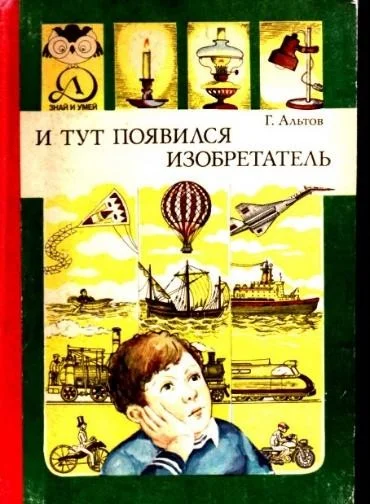
A significant event was the publication of Altshuller’s first TRIZ book for children—“And Suddenly the Inventor Appeared” (“I tut poyavilsya izobretatel”). This was no longer just instructional material for engineers. TRIZ was increasingly entering the education of schoolchildren and work on developing creative thinking.
Sources: Presentation “The History of TRIZ”; V. Petrov, “HISTORY OF TRIZ DEVELOPMENT”; V. Petrov, “Emergence and Development of the System of Standards.”
1985—ARIZ-85 and the System of 76 Standards
The year 1985 holds a special place in the history of TRIZ. The versions ARIZ-85A, ARIZ-85B, and ARIZ-85V were created and refined. Simultaneously, the system of Standards reached the variant of 76 Standards. These two lines—ARIZ and the Standards—became ever more closely linked with the use of resources, Substance-Field transformations, physical effects, and the analysis of Physical Contradictions.
ARIZ-85B
ARIZ-85B consisted of eight parts and 32 steps. The separate part “Selecting the Problem” was removed. Instead, work with the problem model, operative zone, operative time, and Substance-Field Resources (SFR) was strengthened. A dedicated part, “Mobilization and Application of SFR,” appeared. The X-element was directly introduced into the formulation of IFR-1.
ARIZ-85V
ARIZ-85V became the most developed classical version of Altshuller’s ARIZ. In materials on the history of ARIZ, it is regarded as the culmination of a long line of development that began with the 1956 methodology. In this version, the analysis of conflict in time, the use of resources, reference to the information fund, Standards, and analogous problems, as well as the analysis of the solution process itself, were strengthened.
If we look at the path from ARIZ-56 to ARIZ-85V, a general trend is visible: from a relatively short sequence of steps to a multilevel system in which Technical and Physical Contradictions, IFR, operative zone and time, resources, Su-Field analysis, Standards, and physical effects are mutually interconnected.
Sources: V. Petrov, “History of the Development of the Algorithm for Inventive Problem Solving—ARIZ”; V. Petrov, “History of the Creation and Development of TRIZ—Text Distribution Across Slides.”
The System of 76 Standards
In 1985, the system of 76 Standards appeared—the final system of Standards developed by Altshuller. It continued structuring the Standards into classes and subclasses, refined transitions between different types of Substance-Field systems, and added new ways of intensifying and utilizing effects.
For me, the history of the Standards is also important because I systematically analyzed the changes in each new version, prepared reference guides for students and instructors, and compared the systems with one another. In 1985, a comparative analysis of the systems of 76 and 69 Standards and a separate reference guide on the system of 76 Standards were prepared.
Sources: V. Petrov, “Emergence and Development of the System of Standards”; V. Petrov, “HISTORY OF TRIZ DEVELOPMENT.”
Petrozavodsk-85—Analyzing the Evolution Trends of TRIZ Itself
By 1985, it had become important not only to create new variants of tools, but also to investigate how the tools of TRIZ themselves evolve. At the Petrozavodsk conference of developers and teachers, Ester Zlotina and I presented the results of a multi-year analysis of the development of ARIZ, the Inventive Principles, and the Standards.
I had begun researching the history of ARIZ back in 1973. In 1985, this work was carried out jointly with E. Zlotina. Separate materials were prepared: “Trends in the Evolution of ARIZ,” “Trends in the Evolution of Principles,” and “Trends in the Evolution of Standards.” For me, this was a natural extension of TRIZ itself: if technical systems follow laws of evolution, then it makes sense to analyze the regularities governing the evolution of the tools designed to work with those systems.
Sources: V. Petrov, “History of the Development of the Algorithm for Inventive Problem Solving—ARIZ”; V. Petrov, “HISTORY OF TRIZ DEVELOPMENT.”
Life Strategy of the Creative Personality
In the mid-1980s, Altshuller moved increasingly clearly beyond the bounds of engineering creativity proper. In 1985, the first presentation appeared of the direction that subsequently developed as the Life Strategy of the Creative Personality—LSTP (ZhSTL). Together with Igor Vertkin, Altshuller studied the biographies of people who set major creative goals for themselves, attempting to identify typical moves, obstacles, and modes of behavior.
For the history of TRIZ, this is fundamental: the initial task—learning how to solve inventive problems—gradually expanded to the question of how a person chooses a worthy goal and organizes decades of work to achieve it.
“Profession—Search for the New” and “To Find an Idea”

In 1985, the book “Profession—Search for the New” by G. S. Altshuller, B. L. Zlotin, and V. I. Filatov was published, linking TRIZ with Value Engineering (Functional-Cost Analysis) and the search for reserves to improve efficiency.

In 1986, “To Find an Idea: Introduction to the Theory of Inventive Problem Solving” (“Nayti ideyu”) was published. This book became one of the best-known systematic expositions of late-period TRIZ.
1985–1986—The Beginning of TRIZ Computerization
During this same period, development began on the “Invention Machine” project—the computer branch of TRIZ. This was a logical continuation of Altshuller’s decades-long drive to formalize strong problem-solving principles and present the process of working on a problem as a reproducible system.
Computerization did not mean an attempt simply to replace the inventor with a machine. For the developers, it was more important to understand which operations of problem analysis, working with contradictions, resources, and the information fund could be made consistent, repeatable, and suitable for software implementation.
In 1986, a transition to new organizational forms began simultaneously. Materials on the history of TRIZ note the creation of the Kishinev Center “Progress” under the scientific guidance of B. Zlotin and, somewhat later, the Leningrad cooperative “Tvorchestvo” (“Creativity”), which I headed. This was already a step from public seminars and schools toward specialized organizations working on the application of TRIZ.
1987–1989—Theory, Pedagogy, Books, and Organizations
In 1987–1989, TRIZ continued to expand simultaneously as a theory, an educational system, and a professional movement. LSTP (ZhSTL) developed, geometrical effects were investigated, and work continued on forecasting, resources, and the evolution of collectives.
The Petrozavodsk Series “Technology—Youth—Creativity”

In Petrozavodsk, publication of the book series “Technology—Youth—Creativity” (“Tekhnika—molodyozh—tvorchestvo”) began. This series played a major role in disseminating TRIZ: methodological materials, problems, stories about creativity, and texts by developers were brought together under a single publishing initiative.
Books for Teaching Creativity



During this period, an entire group of books aimed at different audiences was published. In 1987—“And Start Inventing.” In 1988—“A Thread in the Labyrinth” and “A Month Under the Stars of Fantasy.” In 1989—“Search for New Ideas: From Insight to Technology,” “Rules of a Game Without Rules,” and “An Inventor Came to Class.”
1988—Theory of the Evolution of Collectives and the Seminar in Miass
In 1988, the line of research into collectives developed. Materials from this period note the first presentation of the theory of the evolution of collectives, associated primarily with the work of B. Zlotin and his colleagues. A scientific seminar was held in Miass, which historical materials characterize as an event that made a major contribution to the development of TRIZ.
Simultaneously, research continued on LSTP (ZhSTL), chemical and geometrical effects, laws of systems evolution, forecasting methods, technical processes, and the application of TRIZ in radio engineering.
1989—Creation of the TRIZ Association
In 1989, the creation of the TRIZ Association began. This was an important organizational transition: a movement that for decades had existed as a network of schools, seminars, individual laboratories, and developer groups acquired a formal professional public structure.
In that same year, the Minsk cooperative “Scientific Research Laboratory of Inventing Machines”—NILIM—was registered, headed by V. Tsourikov. Development of the “Invention Machine” software product continued. Thus, by the late 1980s, alongside classical TRIZ there already existed computer implementations, private organizations, publishing projects, and specialized research groups.
Sources: V. Petrov, “HISTORY OF TRIZ DEVELOPMENT”; presentation “The History of TRIZ.”
Altshuller’s Seminars—The Living School of TRIZ

I want to preserve photographs of Altshuller at seminars separately. They show not only the formal author of the theory, but also his manner of teaching. In this photograph, he is holding his nose—a characteristic gesture that seminar participants remembered well. I noticed that after classes, some of us involuntarily began repeating this habit.

In the second photograph is the conclusion of a seminar. Altshuller has been presented with flowers, and he is delivering his closing remarks. For me, such images matter because the history of TRIZ consisted not only of algorithms, tables, and books. Personal meetings, debates, joint problem analysis, and the atmosphere of the seminars played an enormous role.
1990—The MATRIZ Council
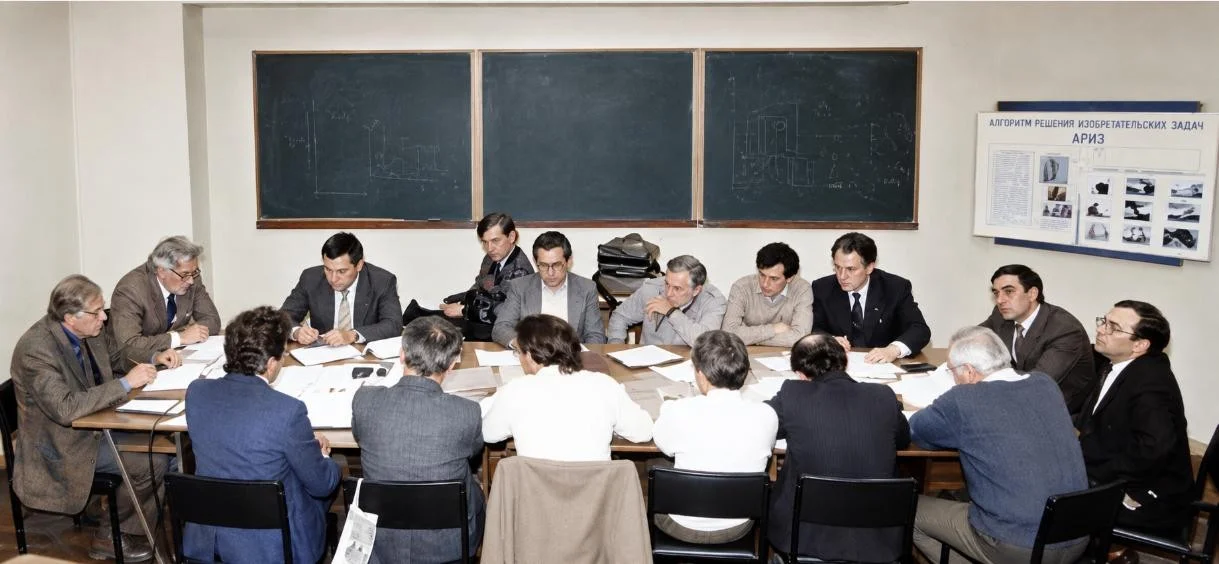
In the photograph is a meeting of the MATRIZ Council in Leningrad in 1990. Genrich Saulovich Altshuller is chairing the meeting. Sitting to his left is Volyuslav Mitrofanov, and to his right, with my back to the photographer, is me. Other council members are also seated around the table.
For the history of TRIZ, this photograph is symbolic. What had begun in the 1940s as a joint search by two young inventors had by 1990 turned into an internationally oriented professional movement with its own researchers, instructors, organizations, books, computer programs, and professional council.
At the Turn of the 1990s
By 1990, publication of the “Journal of TRIZ” (“Zhurnal TRIZ”) began. The computer branch continued, including work on “Problem Formulator.” Large-scale emigration of TRIZ specialists outside the USSR began. This created a new situation: in the following decade, TRIZ would spread ever more rapidly in Israel, the United States, Germany, and other countries.
At this milestone, one major historical stage comes to an end. Over the course of roughly forty years, TRIZ traveled the path from the first attempts to find regularities in inventing to an advanced complex of tools: ARIZ, Inventive Principles, Standards, Su-Field analysis, laws of systems evolution, information funds, RTV, LSTP (ZhSTL), and forecasting methods. Simultaneously, a community of developers emerged that was already capable of continuing the development of individual directions independently.
The next part should cover the years 1990–2003: the “Journal of TRIZ,” international dissemination, Ideation International, Invention Machine, The TRIZ Journal, the Altshuller Institute, the development of TRIZ pedagogy, the final years of Genrich Saulovich’s life, and my personal recollections, including our last telephone conversation on September 23, 1998.
Part 6. 1990–2003
1990—A New Stage
In 1990, publication of the “Journal of TRIZ” began. For the community, this was an important event: a specialized periodical had appeared in which new theoretical developments, methodological materials, and results of applying TRIZ could be published.
The computer branch continued. A theory of automated problem formulation and the “Problem Formulator” computer system were developed. At the same time, Yu. P. Salamatov’s book “How to Become an Inventor” and Yu. M. Chyapale’s “Methods for Searching for Inventive Ideas” were published.

Large-scale emigration of TRIZ specialists for permanent residence in Israel, the United States, Germany, and other countries began. This became one of the factors behind the subsequent rapid international spread of TRIZ.
Sources: V. Petrov, “HISTORY OF TRIZ DEVELOPMENT”; presentation “The History of TRIZ.”
Petrozavodsk, 1991
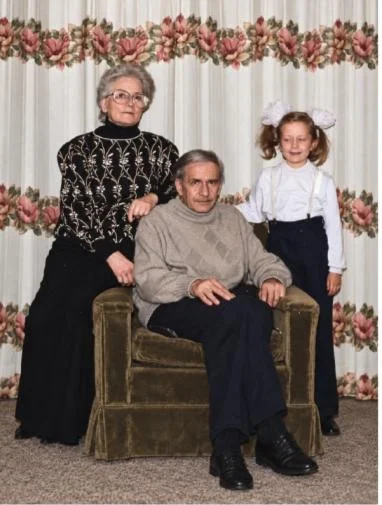
By the early 1990s, Genrich Saulovich and Valentina Nikolayevna were living in Petrozavodsk. This photograph is especially important because it shows neither an official seminar nor a working meeting, but the family side of Altshuller’s life.
Sources: Presentation “The History of TRIZ”; V. Petrov’s caption to the photograph.
1991—Books and International Contacts
In 1991, the second expanded edition of the book “To Find an Idea,” the collection “How to Become a Heretic,” and the book “Chance for Adventure” were published. Development of the methodology for solving research problems continued.


During this same period, teaching outside the former USSR expanded. The presentation materials specifically note the opening of the Center for Scientific and Technical Creativity in Vietnam.
Sources: V. Petrov, “HISTORY OF TRIZ DEVELOPMENT”; presentation “The History of TRIZ.”
1992—Ideation International
In 1992, the company Ideation International Inc. was founded in the United States. Boris Zlotin headed its scientific direction, working alongside Alla Zusman. TRIZ methods and computer software to support problem solving were developed.
I specifically emphasize the role of Boris Zlotin. In my opinion, his contribution to the scientific foundation and methodological development of the company was decisive. At the same time, of course, other specialists and investors also participated in establishing and running the company.
Simultaneously, instructional materials continued to be published: “Ladder of Ideas,” “ABC of Inventing,” and manuals on solving TRIZ training problems.
Sources: V. Petrov, “History of the Creation and Development of TRIZ—Text Distribution Across Slides”; presentation “The History of TRIZ.”
1993–1996—Rapid Expansion of Areas of Application
In 1993–1996, TRIZ noticeably expanded its scope of application. TRIZ pedagogy developed, works on applying principles in journalism and advertising appeared, and the implementation of computer programs continued. In 1993, the company Invention Machine was founded.
In 1994, the book “How to Become a Genius: Life Strategy of the Creative Personality” by G. S. Altshuller and I. M. Vertkin and the book “Formulas of Creativity, or How to Learn to Invent” by G. I. Ivanov were published.

In 1995, development of the Directed Evolution methodology began. In 1996, Ideation International released its first programs for Windows—Appetizer, Improver, and Ideator.
Sources: V. Petrov, “HISTORY OF TRIZ DEVELOPMENT”; presentation “The History of TRIZ.”
1996—The TRIZ Journal and English Editions
In 1996, the American publication The TRIZ Journal was launched. Its founder and editor was Ellen Domb. This became an important step in creating an international English-language information space for TRIZ.
In that same year, the English translation of Altshuller’s book “I tut poyavilsya izobretatel”—And Suddenly the Inventor Appeared, translated by Lev Shulyak—was published.
Publications in English significantly broadened access to classical TRIZ outside the Russian-speaking world.
1997—New Translations and Research
In 1997, the international dissemination of Altshuller’s classical works continued. The English edition “40 Principles: TRIZ Keys to Technical Innovation,” translated and edited by Lev Shulyak and Steven Rodman, was published. Spanish and Japanese editions also appeared.
During this same period, Ester Zlotina and I prepared the work “Structural Substance-Field Analysis.” The development of TRIZ was now proceeding simultaneously in several countries and in several languages.
The Final Years of Genrich Saulovich
In his final years, Genrich Saulovich’s health deteriorated. After our move to Israel in 1990, Ester and I initially communicated with him mainly by mail, and later called more frequently. Starting in 1997, conversations usually took place through Valentina Nikolayevna, because it was becoming increasingly difficult to understand Genrich.
Yet our connection never ceased. For me, this was a continuation not only of a professional relationship with a teacher, but also of many years of personal friendship.
The Last Telephone Conversation
September 23, 1998
Ester and I called Altshuller. Because of his condition, our recent conversations had usually taken place through Valentina Nikolayevna. And suddenly something unexpected happened: Genrich spoke quite clearly. We were overjoyed and concluded that his condition had improved.
September 24, 1998
The next day, Valentina Nikolayevna called and told us that Genrich was gone.
For us, this news came as a shock. Our last conversation had taken place just one day before his death, and for that very reason it has remained especially vividly etched in my memory.
Genrich Saulovich Altshuller. 1926–1998
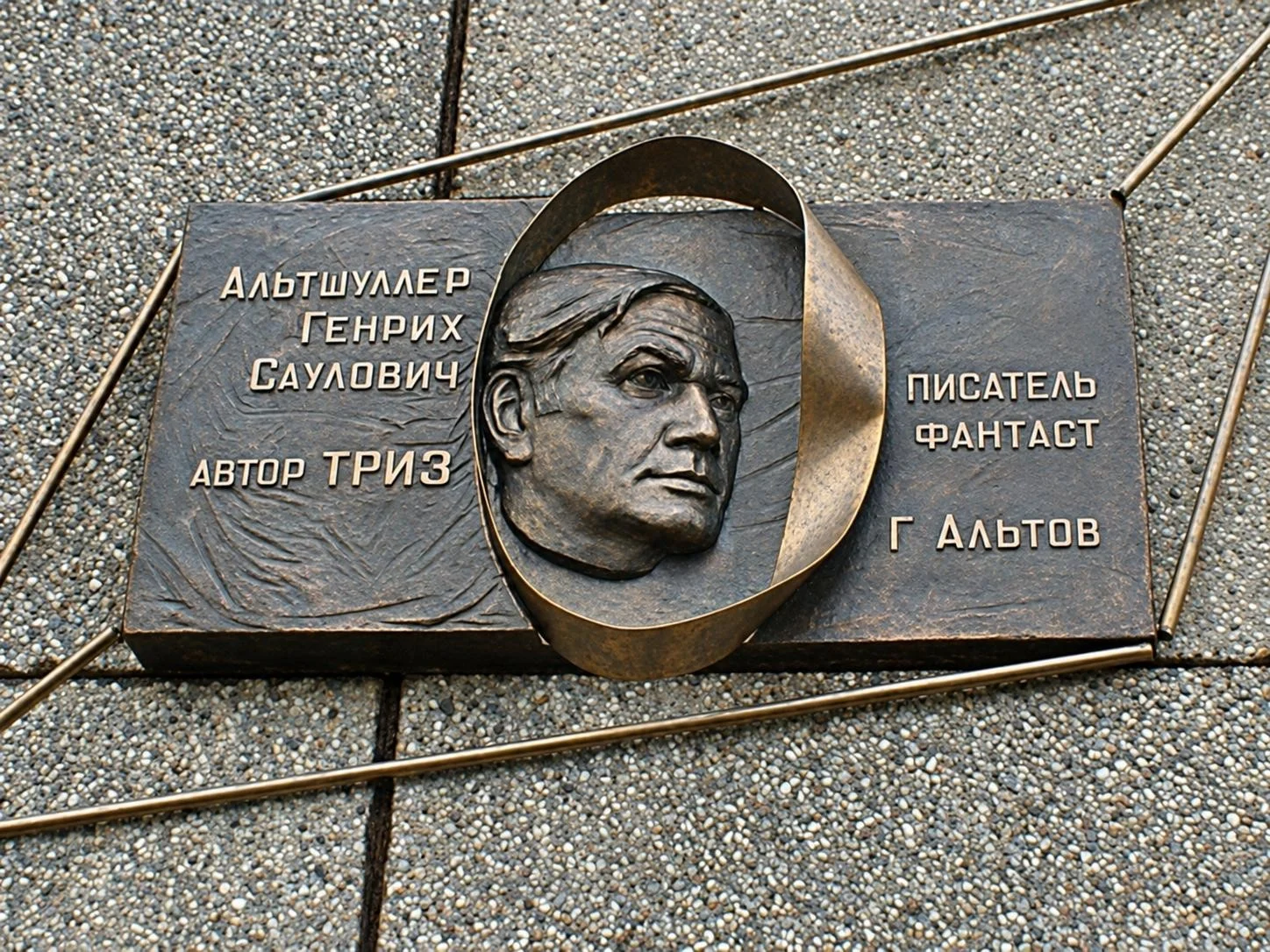
Genrich Saulovich Altshuller died on September 24, 1998. He left behind not merely an isolated problem-solving method, but an entire system: ARIZ, Inventive Principles, Standards, Su-Field analysis, laws of technical systems evolution, Creative Imagination Development, and the Life Strategy of the Creative Personality.
Yet for me, the story of Altshuller is not just a list of the tools he created. I knew him as a teacher, colleague, and friend. Therefore, in this book, alongside documents and chronology, I preserve personal memories: conversations, seminars, debates, photographs, and episodes that cannot be reconstructed from published books alone.
1998–2003—TRIZ After Altshuller
The death of the creator of TRIZ did not halt the development of the field he founded. In 1998, the Altshuller Institute was established in the United States. Lev Shulyak was one of its founders and its first president.
Starting in 1999, TRIZCON was held. In 2000, the European organization ETRIA was founded, and since 2001 the TRIZ Future conference has been held. The international movement became increasingly distributed: national associations, conferences, and new publishing projects emerged.
In 1999, “The Innovation Algorithm” was published in English, along with a whole series of books and materials on classical TRIZ and its further developments.
In 2002, the science fiction collection “Flying Through the Universe” (“Letyashchie po Vselennoy”) by Genrich Altov and Valentina Zhuravleva was published.
Sources: V. Petrov, “HISTORY OF TRIZ DEVELOPMENT”; V. Petrov, “History of the Creation and Development of TRIZ—Text Distribution Across Slides”; presentation “The History of TRIZ.”
Summary of the 1990–2003 Period
During this period, TRIZ definitively ceased to be a predominantly Soviet or Russian-language movement. International companies, journals, institutes, conferences, translations, and software products emerged. Simultaneously, pedagogy, forecasting, LSTP (ZhSTL), systems research methods, and new areas of application developed.
The main change was that further development could no longer be tied to just a single center or a single author. By this time, an international community of researchers and instructors existed that was capable of continuing the work independently.
Sources: V. Petrov, “HISTORY OF TRIZ DEVELOPMENT”; presentation “The History of TRIZ.”
Transition to the Development of TRIZ Tools
Following the historical section, it is necessary to show separately the development of the main TRIZ tools. The following sections will assemble into a unified sequence materials on the evolution of ARIZ, the logic of ARIZ, the Inventive Principles, the Standards, physical, chemical, geometrical, and other effects, Su-Field analysis, and the laws of systems evolution.
Of particular importance here are the specialized books submitted on the history of ARIZ, the Principles, the Standards, and the Laws. They will be used not as brief reference notes, but as full-fledged historical material.
Part 7. History of the Development of ARIZ
How the Name Itself Changed
Initially, the problem-solving sequence was called the “scheme of the creative process” or the “scientific methodology of working on an invention.” Later, the name “methodology of inventive creativity” was used. In 1964, the expression “algorithm for inventive problem solving” appeared. The abbreviation ARIZ appeared in 1968, and in print in 1969.
General Line of ARIZ Development
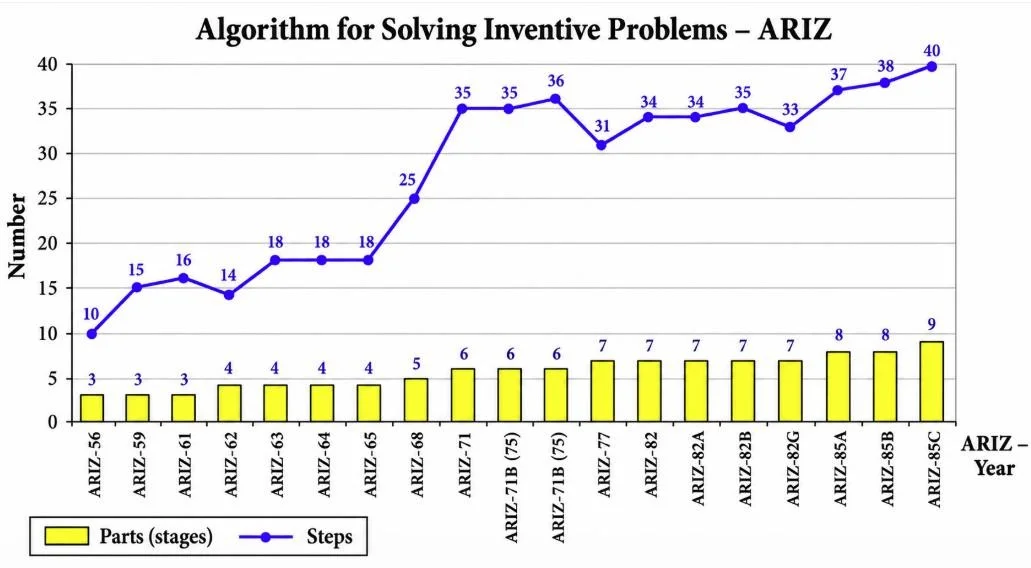
The chart shows the quantitative side of the development of ARIZ. However, an increase in the number of steps is not in itself a measure of quality. More significant is how the logic of problem analysis changed: from a general sequence of recommendations—to building a conflict model, formulating the IFR and Physical Contradiction, and working with the operative zone, operative time, resources, Standards, and the information fund.
Sources: Presentation “The History of TRIZ”; V. Petrov, “History of the Development of the Algorithm for Inventive Problem Solving—ARIZ.”
Summary Chronology of Modifications
Version | Year | Parts | Steps | Main Change |
|---|---|---|---|---|
ARIZ-56 | 1956 | 3 | 10 | First published methodology; 5 analogies. |
ARIZ-59 | 1959 | 3 | 15 | IFR introduced; conditions for removing contradiction; feedback. |
ARIZ-61 | 1961 | 3 | 16 | Operative stage expanded; 22 principles. |
ARIZ-62 | 1962 | 4 | 16 | Problem selection stage; table of principles; physico-chemical cause of interference. |
ARIZ-63 | 1963 | 4 | 18 | Ultimate goal, bypass problem; the form of a principle takes shape for the first time. |
ARIZ-64 | 1964 | 4 | 18 | Name “algorithm for inventive problem solving” appears; 16×16 table. |
ARIZ-65 | 1965 | 4 | 18 | Logic of ARIZ-63/64 retained; table refined. |
Version | Year | Parts | Steps | Main Change |
|---|---|---|---|---|
ARIZ-68 | 1968 | 5 | 25 | New stage of clarifying conditions; prototype of STC operator; abbreviation ARIZ appears. |
ARIZ-71 | 1971 | 6 | 35 | 40 principles, 39 parameters, 39×39 table; new preliminary evaluation part. |
ARIZ-71B | 1975 | 6 | 35 | System Operator, Su-Field notation, Physical Contradiction. |
ARIZ-71V | 1975 | 6 | 36 | Problem model refined; full and brief formulations of PC. |
ARIZ-77 | 1977 | 7 | 31 | Conflicting pair, operative zone, principles for resolving PC, analysis of solution course. |
ARIZ-82 | 1982 | 7 | 34 | Mini-problem, X-element, PC at macro- and micro-levels, MLP. |
ARIZ-82A | 1982 | 7 | — | Fragment of Parts 2–4; remaining parts retained. |
ARIZ-82B | 1982 | 7 | — | Fragment of Parts 2–4; main working part of the version. |
ARIZ-82V | 1982 | 7 | 36 | Intensified formulation of the problem model. |
ARIZ-82G | 1983 | 7 | 37 | Su-Field formula; expanded explanatory apparatus. |
ARIZ-85A | 1983 | 7 | 38 | Operative time, intensified IFR-1, IFR-2. |
ARIZ-85B | 1985 | 8 | 32 | Separate problem selection part removed; work with SFR singled out. |
ARIZ-85V | 1985 | 9 | 40 | Classical most developed version; Standards, information fund, SFR, problem replacement. |
Sources: Summary table compiled according to V. Petrov, “History of the Development of the Algorithm for Inventive Problem Solving—ARIZ.”
ARIZ-56—The First Published Methodology
ARIZ-56 had three stages: analytical—4 steps, operative—2 steps, and synthetic—4 steps. In total—10 steps. Five principles were used as the search apparatus, representing analogies and prototypes of the later system of principles.
The logic was still relatively simple: state the problem, identify the Technical Contradiction and its cause, then find a transformation that eliminates this contradiction, and verify the consequences of the change.
ARIZ-59—Emergence of the IFR
ARIZ-59 retained three stages, but grew to 15 steps and 18 principles. In the analytical stage, the concept of the “Ideal Final Result” appeared for the first time. A special step was also introduced to determine the conditions under which the contradiction could be removed.
In the operative stage, feedback appeared: if a solution is not found, it is suggested to return to the initial problem and broaden its conditions, effectively transitioning to another, more general problem.
Sources: G. S. Altshuller, R. B. Shapiro, “Expulsion of the Six-Winged Seraph,” 1959; V. Petrov, history of ARIZ.
ARIZ-61—Expansion of the Search Apparatus
ARIZ-61 also consisted of three stages, but already included 16 steps and 22 principles. In the operative stage, a special step appeared for checking the possibility of dividing the object into independent parts, and the set of search principles was expanded.
Sources: G. S. Altshuller, “How to Learn to Invent,” 1961; V. Petrov, history of ARIZ.
ARIZ-62—Problem Selection and the Table of Principles
ARIZ-62 already had four stages: problem selection, analytical, operative, and synthetic. In total—16 steps and 36 principles divided into 10 groups. These groups were prototypes of the future universal parameters.
A separate stage, “Selecting the Problem,” was introduced.
The IFR was temporarily called the “ideal desirable result.”
The concept of a physical or chemical cause of interference appeared.
A table of principles was used in the operative stage.
The concept of the inverse problem appeared.
At this point, the methodology begins transitioning from a general heuristic guide to a more structured system for problem transformation.
ARIZ-63—Ultimate Goal and Bypass Problem
ARIZ-63 included 18 steps. In the first stage, determining the ultimate goal and the concept of a bypass problem appeared. In the analytical stage, the name “Ideal Final Result” returned. For the first time, the concept of a principle took clearer shape: 7 principles and 39 sub-principles.
Checking for changes in the external environment and neighboring objects, as well as turning to prototypes in nature, returned to the operative stage.
ARIZ-64 and ARIZ-65—Transition to the Algorithm Proper
ARIZ-64 had four stages and 18 steps. It included 31 principles, 36 sub-principles, 16 universal parameters, and a 16×16 table. It was in 1964 that the name “algorithm for inventive problem solving” appeared.
In structure, ARIZ-65 was close to ARIZ-63 and ARIZ-64. The main changes involved refining and filling in the table of principles.
ARIZ-68—Emergence of the Abbreviation ARIZ Itself
ARIZ-68 consisted of five stages and 25 steps, and included 35 principles, 48 sub-principles, 32 universal parameters, and a 32×32 table. The first major stage was split: a separate stage, “Clarifying the Problem Conditions,” appeared.
In this stage, a prototype of the STC operator—changing size, time, and cost—appeared. It was in this version that the abbreviation ARIZ appeared.
ARIZ-71—Mature Structure of the Early 1970s
ARIZ-71 already had six parts and 35 steps. It used 40 principles, 88 sub-principles, 39 universal parameters, and a 39×39 table.
A new part, “Preliminary Evaluation of the Found Idea,” was introduced.
The STC operator was formalized as a dedicated step.
The abbreviation IFR (IKR) appeared.
“Before” and “After” drawings were used.
A prototype of the operative zone appeared.
A prototype of the MLP (Modeling with Little People) method appeared.
Physical effects and a prototype of principles for resolving a Physical Contradiction in time appeared in the operative stage.
Beyond the steps themselves, the text of ARIZ became an instructional tool: examples, notes, auxiliary questions, and checks were incorporated into it.
ARIZ-71B (1975)—Physical Contradiction
ARIZ-71B retained six parts and 35 steps, but the logic changed substantially. In the first part, the System Operator appeared for selecting the desirable level of solution. In the second part, a problem model was built, and conditions began to be recorded in Su-Field form.
In the analytical part, the concept of the Physical Contradiction was introduced. This is one of the key stages in the development of the entire ARIZ: the search shifts from a general Technical Contradiction to incompatible requirements placed upon a single element of the system.
ARIZ-71V (1975)—Refining the Model and Formulating the PC
ARIZ-71V was a further refinement of the previous version. Additional rules and a table for selecting conflicting pairs appeared in building the problem model. Recording the problem conditions in Su-Field form was singled out as a separate step.
The Physical Contradiction began to be formulated in full and brief forms; a PC diagram and control questions for verifying the solution appeared.
ARIZ-77—Conflicting Pair and Operative Zone
ARIZ-77 had seven parts and 31 steps. This was a major restructuring of the algorithm.
The concept of the “conflicting pair” was formulated.
The concept of the “operative zone” was introduced.
The STC operator was moved to the first part.
Resolving the PC was linked to separating opposite properties in space, time, and structure, as well as to transition states.
A dedicated step for using physical effects was restored.
A separate part, “Analysis of the Solution Course,” appeared.
The last point is especially important: a solved problem should not only yield a result, but also improve the method of solving itself—that is, raise the skill level of the ARIZ user.
ARIZ-82—Mini-Problem, X-Element, and Two Levels of PC
ARIZ-82 included seven parts, 34 steps, 7 rules, and 26 notes. Work with the problem model was sharply strengthened in it.
The concept of the mini-problem was introduced.
The X-element appeared.
A graphical conflict diagram appeared.
The Physical Contradiction is formulated at the macro-level and micro-level.
The use of the Method of Modeling with Little People (MLP) was introduced.
A table of typical conflicts and a table for resolving Physical Contradictions appeared.
A prototype of working with Substance-Field Resources appeared.
The solution logic increasingly narrows the field of analysis: initial situation—mini-problem—problem model—operative zone—IFR—Physical Contradiction.
ARIZ-82A and ARIZ-82B—Working Revision of the Central Parts
ARIZ-82A and ARIZ-82B existed as revised fragments of the central parts of the algorithm. The remaining parts were retained from the previous version. This is important: not every modification of ARIZ was immediately a completely rewritten standalone system.
In the ARIZ-82B materials, Altshuller specifically emphasized that the parts devoted to building and analyzing the problem model and eliminating the Physical Contradiction constitute the main working core of modern ARIZ.
ARIZ-82V and ARIZ-82G—Intensifying the Conflict and the Su-Field Formula
ARIZ-82V contained 36 steps. Its main innovation was an intensified formulation of the problem model—that is, bringing the states of the elements to an extreme conflict.
ARIZ-82G had 37 steps. A step for constructing a Su-Field formula was added to the problem analysis, and the explanatory apparatus was significantly expanded: special “Attention” warnings appeared.
ARIZ-85A—Operative Time and IFR-2
ARIZ-85A had seven parts and 38 steps. This version introduced the concepts of operative time and the intensified formulations of IFR-1 and IFR-2. The concept of the extreme IFR also appeared: the product processes itself without a special tool.
The system of principles for resolving a Physical Contradiction was expanded to 11 principles.
ARIZ-85B—Resources as an Independent Part
ARIZ-85B had eight parts and 32 steps. The separate problem selection part was excluded.
In its place, analysis of the problem model and work with resources were strengthened.
A dedicated part, “Mobilization and Application of SFR,” was singled out.
Operative zone, operative time, and resources were brought together into a unified logic of analysis.
The X-element was incorporated into the formulation of IFR-1.
Rules, notes, and warnings were significantly expanded.
This is an important transition: resources cease to be an auxiliary remark and become an independent object of systematic search.
ARIZ-85V—The Final Classical Version
ARIZ-85V had nine parts and 40 steps. It contained 10 rules and 44 notes. This is the most developed classical version of Altshuller’s ARIZ.
Application of the Standards was introduced into the problem analysis.
The structure and methodology for identifying Substance-Field Resources were refined.
A separate block, “Changing and (or) Replacing the Problem,” was introduced.
Standards, physical effects, and analogous problems are used in the information fund.
Work with the found solution principle and its transfer to other problems is developed.
The concluding part requires comparing the actual course of solution with the theoretical course according to ARIZ.
The text of the version itself emphasizes: ARIZ is a tool for thinking, not a substitute for thinking. It is intended primarily for non-standard problems and requires prior training.
Evolution of the Logic of ARIZ
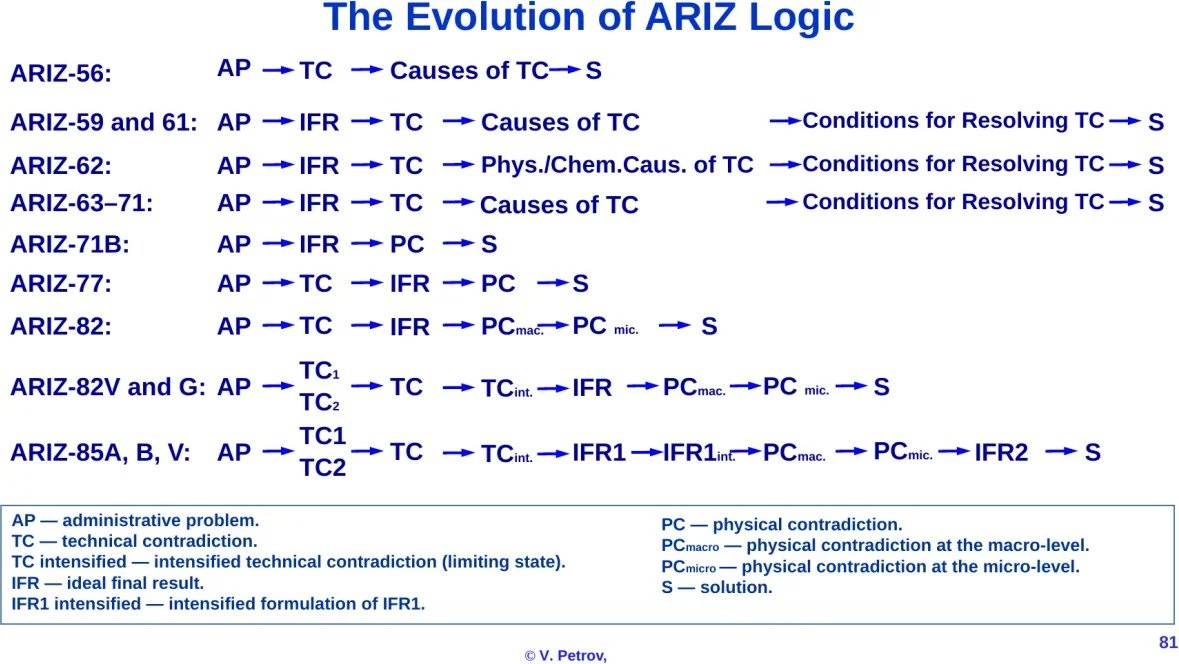
This diagram shows not the quantitative, but the substantive path of development. In ARIZ-56, the main chain ran from an administrative problem to a Technical Contradiction, its causes, and the solution. In ARIZ-59 and ARIZ-61, the IFR appeared between the problem and the contradiction.
ARIZ-62 introduced the search for the physical or chemical cause of the Technical Contradiction. ARIZ-71B made the Physical Contradiction primary. ARIZ-77 once again linked the Technical Contradiction, IFR, and PC into a single chain.
ARIZ-82 divided the Physical Contradiction into macro- and micro-levels. In ARIZ-82V and ARIZ-82G, two Technical Contradictions and their intensified formulation appeared. In ARIZ-85A, B, and V, the logic was supplemented by the intensified IFR-1 and IFR-2.
Sources: Presentation “The History of TRIZ”; V. Petrov, “History of the Development of the Algorithm for Inventive Problem Solving—ARIZ.”
Main Trends in the Development of ARIZ
Refining problem formulation: from the initial situation to the mini-problem and conflict model.
Transition from Technical Contradiction to Physical Contradiction.
Narrowing the field of analysis: conflicting pair, operative zone, operative time.
Strengthening idealization: IFR, intensified IFR-1, IFR-2.
Growing role of resources: substances, fields, space, time, and other SFR.
Transition from psychological devices to more precise operators for transforming the problem.
Incorporating the information fund: principles, Standards, and physical, chemical, and other effects.
Emergence of feedback loops and analysis of the solution process itself.
Transition from obtaining a single answer to developing the found principle and transferring it to other problems.
Sources: V. Petrov, “History of the Development of the Algorithm for Inventive Problem Solving—ARIZ.”
My Work on Researching the Development of ARIZ
For me, ARIZ was not only a problem-solving tool, but also an independent object of research. I began analyzing its development in 1973. Later, Ester Zlotina and I continued this work together.
We compared the versions by structure, steps, principles, changes in logic, and the emergence of new concepts. The results were presented at the Petrozavodsk conference in 1985.
It was out of this work that my subsequent materials on the history of ARIZ grew.
Conclusion
The history of ARIZ shows that it was never an algorithm created once and for all.
Each version was the result of testing the previous one on problems, at seminars, and against new theoretical developments.
The main direction of development was not a mechanical increase in the number of steps, but a consistent deepening of the problem model and an increase in the precision of thinking operations. From identifying a general contradiction, ARIZ progressed to working with macro- and micro-level Physical Contradictions, the Ideal Final Result, resources, the information fund, and analysis of one’s own course of solution.
Therefore, ARIZ-85V should be viewed not as an isolated text from 1985, but as the culmination of decades of development of the method.
Part 8. History of the Development of the Inventive Principles
Emergence of the Principles as a Tool for Inventive Problem Solving
The principles for eliminating Technical Contradictions emerged during the work of G. S. Altshuller and R. B. Shapiro on the methodology for solving inventive problems. Analyzing the history of technology and the patent fund, they concluded that when solving an inventive problem, it is necessary to identify and resolve a Technical Contradiction. Alongside the algorithm for inventive problem solving, special ways of resolving such contradictions began to take shape—the future Inventive Principles.
Initially, the principles developed as an integral part of ARIZ. Later, they came to be applied as an independent tool as well. Their content and form took shape gradually: from individual analogies and pointers on the direction for changing an object—to a stable system of principles and a table for selecting them.
Selecting the principles and filling in the table were based on processing the patent fund, as well as on statistical analysis of solutions to practical and instructional problems. The initial screening of inventions was carried out using patent claims, after which the most interesting solutions were examined in detail using the full patent descriptions. As material accumulated, the formulations and recommendations were refined.
1956—Prototypes of Future Principles
In the 1956 methodology, a system of principles in the later sense did not yet exist. Five ways of searching for a solution were used. Two of them were analogies—with nature and with technology. The other three indicated where to look for a change: within the system itself, in the external environment, or in adjacent systems.
At this stage, it was a matter of search directions rather than fully formed principles. Nevertheless, it was right here that the foundational idea appeared: instead of unlimited trial and error, one can use recurring ways of transforming the problem and the object.
1959—Expanding the Set of Ways
In 1959, the number of ways used rose to eighteen. Ten of them related to changes in the object itself, three to changes in the external environment, another three to changes in other, neighboring objects, and two retained the search direction by analogy with nature and technology.
Thus, compared to 1956, the search became noticeably more articulated.
General directions began breaking down into specific transformations. This was an important transition from a few broad guidelines to a more differentiated set of problem-solving tools.
1961—Twenty-Two Ways
The 1961 methodology already listed twenty-two ways. Nine related to changing the object itself, four to changing the external environment, three to changing neighboring objects, four to dividing the object into independent parts, and two to analogies with nature and technology.
What mattered was not only the increase in the number of ways. An internal organization of the material was beginning to emerge: individual ways were grouped by the nature of the transformation. However, a finished structure of a principle and a dedicated selection mechanism did not yet exist.
1962—Linking Ways with Typical Technical Contradictions
In 1962, thirty-six ways of eliminating contradictions were developed. They were presented in a two-column table: “typical technical contradictions” and “typical ways of eliminating technical contradictions.”
The table examined ten typical technical contradictions: unacceptable increase in weight; unacceptable increase in length; unacceptable increase in area; unacceptable increase in object size; unacceptable change in shape; unacceptable increase in power or energy; unacceptable decrease in reliability; unacceptable decrease in productivity; contradictory combination of requirements for the operating conditions of the object; and emergence of harmful factors, such as harmful forces.
Each type of contradiction corresponded to a specific set of ways for eliminating it. Thus, a prototype of the future selection mechanism appeared: the task was no longer merely to have a list of ways, but to link the nature of the contradiction with the most suitable transformations.
1963—Transition to the “Principle—Sub-Principles” Structure
In 1963, the first seven principles were formed, uniting thirty-nine more specific ways that in modern terminology can be viewed as sub-principles. In the materials of that time, these specific ways themselves were still called principles.
A table appeared in which one axis specified the type of Technical Contradiction and the other listed the seven principles. At the intersections, the specific ways recommended for the given case were indicated. This was the next step toward forming the future table for selecting principles.
1964—Formation of the Principle Structure and the Selection Table
In 1964, the structure of a principle that subsequently became standard took shape.
The system included thirty-one principles. To select principles, a table was used in which a Technical Contradiction was described through parameters arranged along rows and columns, while the cells indicated the numbers of the recommended principles.
Many cells in the table still remained empty. Further work was aimed at refining the formulations of the principles and sub-principles and filling in the table more completely as new patent and problem material was processed. The fundamental structure of the system itself did not change after this.
1965—Refining the Formed System
In 1965, the fundamental structure of the system of principles did not change. Editorial revisions of the formulations were carried out, recommendations were adjusted, and additional cells of the table were filled in. In other words, development now proceeded within the established framework.
1968—Thirty-Five Principles
By 1968, the number of basic principles had increased to thirty-five. Simultaneously, the table for selecting them was substantially expanded. These changes resulted from further processing of the patent fund, refinement of the content of the principles, and the accumulation of material from practical and instructional problems.
By this point, the system already possessed all its main elements: formed principles, their more specific variants, and a table linking the nature of a Technical Contradiction with the recommended principles.
1971—Completion of the System of 40 Principles
In 1971, development of the system of forty basic principles for eliminating Technical Contradictions was completed. Simultaneously, the selection table took its final form, constructed as a 39 × 39 matrix: one parameter described what needed to be changed or improved, while the other described what unacceptably deteriorated as a result. At the intersection of the row and column, the numbers of the principles recommended for that combination were indicated.
Thus, by 1971 the system had acquired its completed form: a Technical Contradiction was formulated through two conflicting parameters, after which the table was used to determine the set of principles to be checked first.
How the Principle Selection Table Worked
To apply the table, one first had to identify the Technical Contradiction in the problem. Next, one determined which parameter needed to be changed, improved, increased, or decreased, and which other parameter unacceptably deteriorated as a result. After that, the numbers of the recommended principles were found in the corresponding cell of the table.
As an example, the book “History of the Development of Principles” cites the combination “speed—force.” The cell at the intersection of these parameters lists principles 13, 28, 15, and 19. This example illustrates how the search apparatus works: the table does not replace problem analysis, but is used after the Technical Contradiction has been formulated.
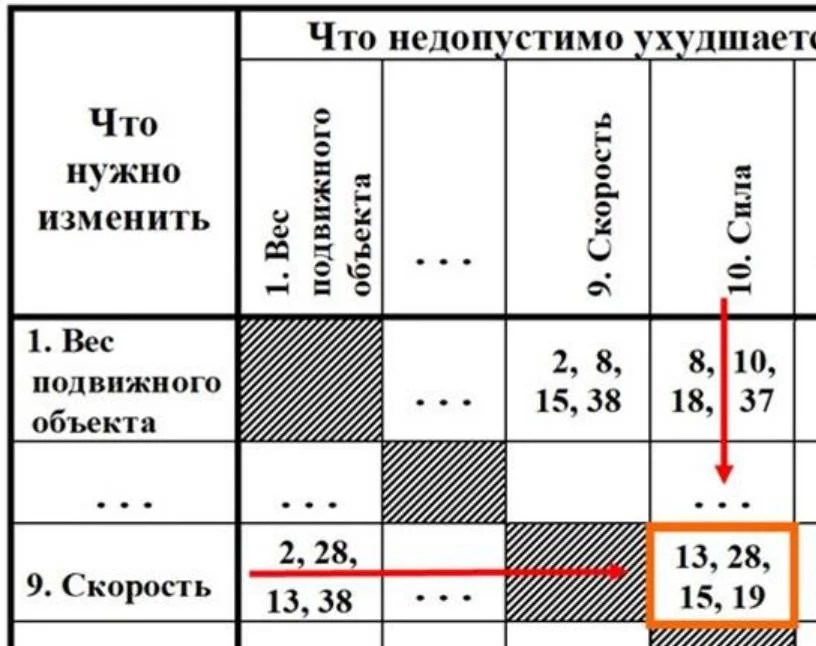
Chronology of the Formation of the System of Principles
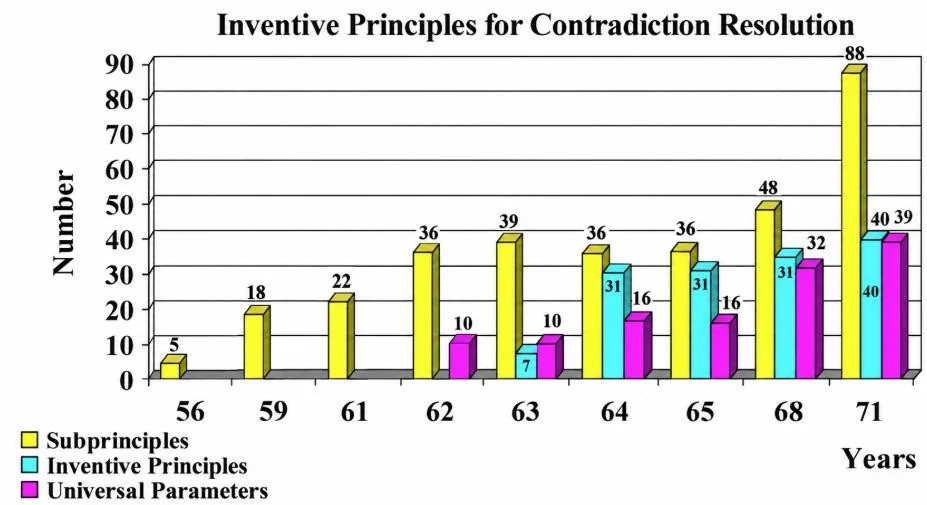
Year | State of the System | Main Change |
|---|---|---|
1956 | 5 ways | Analogies with nature and technology; searching for changes in the system, external environment, and adjacent systems. |
1959 | 18 ways | Expansion and detailing of directions for changing the object and its surroundings. |
1961 | 22 ways | Further systematization, including ways of dividing the object into independent parts. |
1962 | 36 ways | Linking ways with ten typical technical contradictions; prototype of the selection table. |
1963 | 7 principles, 39 sub-principles | Emergence of the “principle—sub-principles” structure and correspondence table. |
1964 | 31 principles | Formation of the principle structure and matrix selection system. |
1965 | 31 principles | Refinement of formulations and filling in the table. |
1968 | 35 principles | Expansion of the system and selection table. |
1971 | 40 principles | Completion of the classical system of 40 principles and the 39 × 39 matrix. |
Sources
Altshuller G. S., Shapiro R. B. “On the Psychology of Inventive Creativity.” — Voprosy Psikhologii, 1956, No. 6. — Pp. 37–49.
Altshuller G. S., Shapiro R. B. “Expulsion of the Six-Winged Seraph.” — Izobretatel i Ratsionalizator, 1959, No. 10. — Pp. 20–30.
Altshuller G. S. “How to Learn to Invent.” — Tambov: Tambov Book Publishing House, 1961. — 128 pp.
Altshuller G. S. “How to Work on an Invention. On the Theory of Inventing” // “ABC of the Rationalizer.” — Tambov: Tambov Book Publishing House, 1963. — Pp. 274–304.
Altshuller G. S. “Foundations of Inventing.” — Voronezh: Central Black Earth Book Publishing House, 1964. — 240 pp.
Korneev S. G. “Algebra and Harmony.” Innovator’s Library, Issue 2. — Tambov: Tambov Book Publishing House, 1964. — 65 pp.
Altshuller G. S. “Attention: The Innovation Algorithm!” — Ekonomicheskaya Gazeta, No. 35, September 1, 1965. Supplement “Technico-Economic Knowledge,” Issue 27 (41). — 16 pp.
Altshuller G. S. “The Innovation Algorithm.” — Moscow: Moskovsky Rabochy, 1969. — 272 pp.
“Algorithm for Inventive Problem Solving ARIZ-68” / compiled by G. S. Altshuller. — Baku: Gyandzhlik, 1970. — 19 pp. (rotaprint).
Altshuller G. S. “Basic Principles for Eliminating Technical Contradictions in Inventive Problem Solving.” — Baku: Gyandzhlik, 1971. — 52 pp.
Altshuller G. S. “The Innovation Algorithm.” — Moscow: Moskovsky Rabochy, 1973. — 296 pp.
Petrov V. “History of the Development of Principles. Information Materials.” — Tel Aviv, 2006.
Comments 0
New comment
No comments yet
Be the first to share your opinion on the publication!